

Your Metabolism Is Meant to Change
“Keep insulin low.”
“Become a fat burner.”
“Avoid blood sugar spikes.”
“Stop burning glucose.”
“Stay in ketosis.”
If you have spent any time reading about metabolic health, you have probably encountered some version of these ideas.
There is real physiology behind many of them. Persistently elevated blood glucose is not healthy. Insulin resistance matters. Excessive energy storage can contribute to metabolic dysfunction. And the ability to use stored fat for energy is an important part of normal metabolism.
But somewhere along the way, a more complicated biological story has often been reduced to the idea that there is one desirable metabolic state we should be trying to achieve.
There isn’t. Your metabolism is supposed to change.
Eat breakfast and nutrients begin arriving from the digestive system. Insulin and other signals help coordinate what happens next. Glucose can be used for immediate energy or stored as glycogen. Amino acids become available for protein synthesis and other functions. Dietary fats can be used, transported or stored.
Several hours later, when food is no longer arriving, the metabolic situation changes. Stored fuels become increasingly important.
Walk briskly uphill and it changes again. Contracting muscles suddenly require much more energy. Fuel use increases, glucose uptake changes, glycogen may be mobilised and mitochondria respond to the increased demand.
Sit quietly afterwards and demand falls. Sleep overnight and the body continues supplying energy even though no food is arriving. Wake, move, eat, work, rest, exercise and sleep, and the metabolic conversation keeps changing.
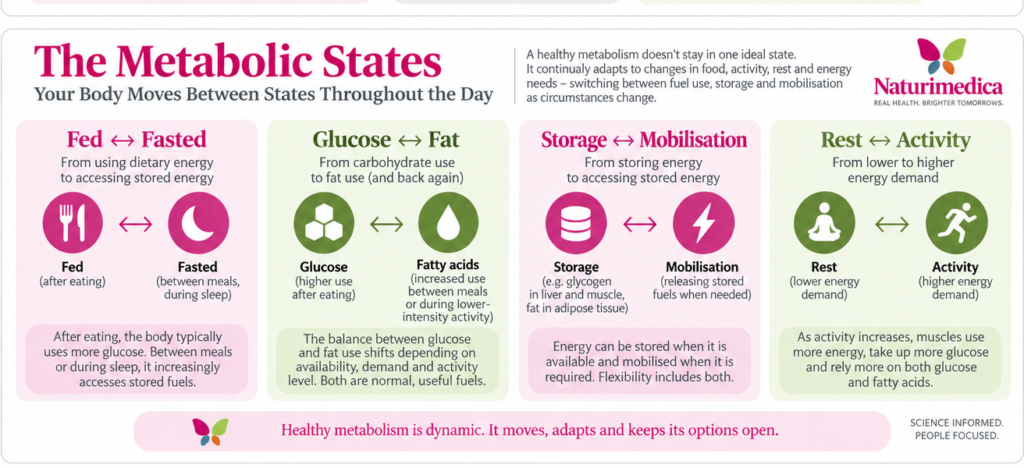
This ability to adjust as conditions change is one of the defining characteristics of a healthy metabolism. It is called metabolic flexibility. At its simplest, metabolic flexibility describes the body’s capacity to adjust how it uses, stores and accesses energy as circumstances change.
That includes moving appropriately between:
FED ↔ FASTED
GLUCOSE ↔ FAT
STORAGE ↔ MOBILISATION
REST ↔ ACTIVITY
These are not opposing metabolic camps in which one side is healthy and the other unhealthy. They are normal physiological states. A healthy metabolism is not one that always burns more glucose or always burns more fat. It is one that can use, store and switch fuels appropriately as availability, demand and biological timing change.
Instead of asking: How can I keep my metabolism in the “right” state? perhaps the better question is: How well can my metabolism adapt when the situation changes?
What Is Metabolic Flexibility?
Metabolic flexibility is not a new wellness concept. The term has been used in metabolic research to describe the body’s ability to alter fuel use in response to changes in nutrient availability and energy demand.
In other words, metabolic flexibility is not about which fuel the body is using at one particular moment. It is about whether fuel use can change appropriately when the metabolic situation changes.
Researchers can investigate this by examining changes in fuel use during fasting and feeding, insulin stimulation, rest and exercise, or different dietary conditions. One tool is the respiratory exchange ratio, or RER. By comparing oxygen consumption with carbon dioxide production, researchers can estimate the relative contribution of carbohydrate and fat to energy production. A higher RER generally indicates greater carbohydrate oxidation, while a lower RER generally reflects greater fat oxidation.
But metabolism is not a switch with only two positions.
During fasting, reliance on stored fat generally increases. After carbohydrate-containing food arrives, carbohydrate oxidation tends to increase. During exercise, fuel use changes again depending on intensity, duration, fitness, glycogen availability and recent food intake.
All healthy people use both glucose and fat. The proportions continually change.
Importantly, researchers do not have one universally accepted test that neatly divides people into “metabolically flexible” and “metabolically inflexible.” Different studies examine different metabolic transitions under different experimental conditions.
For our purposes, metabolic flexibility is therefore best understood as a physiological principle rather than another diagnosis.
Your Metabolism Moves Between States
Several important transitions help us understand what metabolic flexibility looks like in normal physiology.
FED ↔ FASTED
Eating is a metabolic event. When nutrients become available for absorption, insulin and other signals help coordinate their use and storage.
Insulin is sometimes portrayed as a hormone we should minimise as much as possible. But insulin is not a metabolic mistake. It is one of the body’s essential signalling hormones.
After eating, insulin supports glucose uptake in insulin-responsive tissues, helps suppress excessive glucose production by the liver, promotes glycogen storage and influences fat and protein metabolism. This is exactly what should happen in the fed state.
As digestion and absorption decline and several hours pass without additional food, the metabolic situation changes. Insulin levels generally fall, while stored fuels contribute increasingly to the body’s energy needs.
Liver glycogen helps maintain blood glucose. Fatty acids released from adipose tissue provide fuel for many tissues. This is also normal physiology. The body is designed to experience both: energy arriving and energy being drawn from storage.
This is why acknowledging the physiology of fasting does not mean everyone needs prolonged fasting or a rigid intermittent-fasting programme. Metabolic health is not about staying in the fasted state. It is about being able to respond appropriately in both the fed and fasted state.
GLUCOSE ↔ FAT
Glucose and fat are sometimes discussed as though they are competing metabolic teams. Fat burning is portrayed as healthy. Glucose burning is portrayed as something to escape. Human physiology is far more interesting than that.
Glucose is an extremely useful fuel. It can provide energy rapidly when demand increases and can be stored as glycogen in the liver and skeletal muscle. Fat is also an extremely useful fuel. It provides a concentrated form of stored energy and can supply substantial energy during rest, lower-intensity activity and periods when food is not arriving.
Most of the time, the body uses a mixture of both.
After a carbohydrate-containing meal, glucose availability and carbohydrate oxidation generally increase. Between meals and during fasting, fatty-acid availability and oxidation tend to increase. Exercise changes the mixture again according to demand.
The metabolism of these fuels also interacts within cells. The classic glucose-fatty acid or Randle cycle helped establish that greater availability and use of one fuel can influence the metabolism of another. We now know that fuel selection involves a much wider network of substrate availability, insulin signalling, cellular energy status, mitochondrial function, enzyme regulation and physical activity.
The broader lesson remains useful: The fuels we use do not operate in isolation.
Glucose is not a metabolic mistake, and fat burning is not a metabolic achievement. Both are normal parts of human energy metabolism.
The important question is whether the body can use the appropriate fuel when circumstances change.
STORAGE ↔ MOBILISATION
Storage has also acquired an unnecessarily bad reputation. But the ability to store energy is one reason humans can survive between meals, sleep through the night and remain physically active without needing a constant supply of food.
Glycogen provides a relatively accessible carbohydrate reserve. Adipose tissue provides a much larger store of energy as triglycerides. In healthy physiology, these stores are dynamic:
Energy arrives → some is used → some is stored → stored energy can later be mobilised
Problems can arise when this balance becomes persistently disturbed, particularly when energy storage repeatedly exceeds use or when excess lipid begins accumulating in tissues poorly suited to store it.
But storage itself is not the problem. The ability to move between storage and mobilisation is part of metabolic flexibility. This gives us another useful question: Can stored fuel be accessed when it is needed?
REST ↔ ACTIVITY
Energy demand also changes dramatically according to what the body is doing. At rest, skeletal muscle requires relatively little energy. Start walking, climbing, lifting or exercising and demand can rise rapidly.
Working muscle uses ATP, draws on stored and circulating fuels and changes glucose uptake and fuel oxidation according to the intensity and duration of activity. Then demand falls again during rest and recovery. This transition reminds us that metabolic flexibility is not driven only by what we eat.
Fuel availability matters, but so does the body’s need for that fuel.
And that brings us to one of the most useful ways to understand metabolic flexibility: PUSH and PULL.
How does your body know what to do with energy?
At any moment, the metabolic system is integrating information about four broad questions:
- What has just arrived?
- What is already available or stored?
- How much energy is needed right now?
- And when is this happening?
The answer is not determined by one metabolic controller.Hormones, the nervous system, brain, liver, adipose tissue, skeletal muscle and mitochondria all participate in coordinating the response. We explored this organ conversation in more depth in Metabolic Health After 40: Why It’s About More Than Weight, Blood Sugar and Insulin.
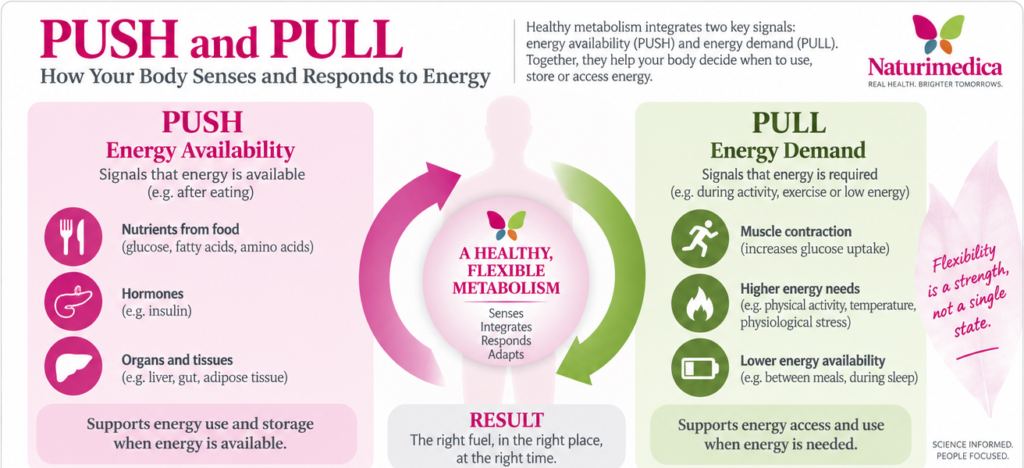
Here, however, there is a simpler way to make sense of one particularly important part of it. Think about metabolism in terms of two interacting forces: PUSH and PULL
PUSH and PULL: Availability Meets Demand
PUSH and PULL are not formal biochemical pathways. They are simply a useful way of visualising something the body does continuously. We can think of one set of signals as reflecting energy availability and another as reflecting energy demand. Healthy metabolism continually integrates both.
PUSH: energy becomes available
- Eat a meal and nutrients enter circulation
- Glucose availability increases
- Amino acids arrive
- Dietary fats are absorbed and transported
- Insulin and other hormonal signals change
Some nutrients can be used immediately. Glycogen stores can be replenished. Protein synthesis can increase. Energy that is not immediately required can be stored.
We can think of this as the PUSH side of metabolism. Energy and nutrients have entered the system and physiology responds to their availability. This does not make insulin the villain pushing calories into fat cells. Insulin is one part of an integrated fed-state response that allows nutrients to be directed towards appropriate destinations. But metabolic health does not depend only on managing what arrives.
There is another powerful signal – Demand.
PULL: energy is required
- Stand up and walk across the room and muscle energy demand increases
- Climb a hill and it rises further
- Lift a heavy weight and contracting muscle needs ATP immediately
The metabolic system responds.
- Muscle glycogen can be used
- Glucose uptake increases
- Fatty acids contribute energy according to the intensity and duration of activity
- Mitochondrial energy production responds to demand
This is the PULL side of metabolism.
Something important happens here that is often missed when metabolic health is discussed almost entirely through insulin. Insulin can stimulate glucose uptake into skeletal muscle after eating. But muscle contraction can also stimulate glucose uptake using signalling mechanisms that are substantially distinct from the insulin pathway.
Movement therefore does not merely “burn calories.” Contracting muscle changes metabolic physiology.
During activity, muscle creates a need for energy and helps draw fuel towards its own use. Afterwards, muscle can remain more sensitive to insulin for a period during recovery, helping replenish glycogen that was used. Much popular metabolic advice concentrates on the PUSH side:
- How many calories are coming in?
- How much carbohydrate are you eating?
- How high is insulin?
- How can we reduce glucose entering the bloodstream?
These can be relevant questions. But they are only half of the conversation. We can also ask:
- How much metabolic demand are we creating?
- Are muscles being used regularly?
- Are glycogen stores being turned over?
- Are cells repeatedly being asked to produce more energy?
- Is there a reason for stored fuel to be mobilised?
This does not mean exercise cancels out food or that energy intake, diet quality and insulin resistance do not matter. It means metabolism responds to both supply and demand.
Food creates availability. Movement creates demand. Healthy metabolism needs to manage both.
And perhaps this gives us a more constructive question than continually asking how to stop energy entering the system: Am I also creating healthy demand for the energy available?
Muscle: One of Your Greatest Metabolic Assets
If PULL is about creating demand for energy, skeletal muscle deserves special attention.
We tend to think of muscle mainly in terms of strength and movement. Metabolically, it does much more. Skeletal muscle is one of the body’s major destinations for glucose after eating, stores glucose as glycogen, uses both glucose and fatty acids for energy and can dramatically increase its energy requirements when it contracts.
This makes muscle one of our most adaptable metabolic tissues.
Muscle can take up glucose in more than one way
After eating, insulin helps stimulate glucose uptake into skeletal muscle, including by promoting movement of GLUT4 glucose transporters towards the muscle-cell membrane. Muscle contraction can also increase glucose uptake through signalling mechanisms that are substantially distinct from insulin signalling.
This becomes particularly relevant when insulin sensitivity is reduced because muscle contraction can still stimulate glucose uptake through pathways that are not identical to insulin signalling. In practical terms, movement provides another physiological stimulus for muscle to take up and use glucose. It creates demand and gives available fuel somewhere useful to go.
Muscle, glycogen and turnover
Muscle stores carbohydrate as glycogen primarily for its own use. During physical activity, particularly as intensity increases, glycogen can be broken down rapidly to help provide energy for contraction. Later, those stores can be replenished.
This creates another normal metabolic cycle: STORE → USE → REPLENISH
Again, the important feature is not avoiding storage. It is turnover.
Following exercise, skeletal muscle can become more sensitive to insulin, supporting glucose uptake and the replenishment of glycogen stores during recovery.
Clinical Pearl
Muscle doesn’t only use energy while you exercise. Muscle contraction changes glucose handling during activity and can increase insulin sensitivity afterwards. This is one reason movement has metabolic effects that extend far beyond the calories used during the activity itself.
Repeated exercise can stimulate adaptations in muscle that improve its capacity to produce and use energy. This does not mean more exercise is always better.
Adaptation requires both challenge and recovery. But it does help explain why maintaining active skeletal muscle becomes increasingly valuable as we get older.
Muscle mass, quality, strength and physical activity can all change with age. Menopause can add another layer through changes in hormones, body composition, sleep, recovery and fat distribution.
We will explore those changes in much greater depth in the next article in this series. For now, the important point is simple:
Muscle is not simply attached to the metabolic system. It is one of its major participants.
And inside those muscle cells, another remarkable part of the metabolic story is continually unfolding.
Mitochondria: Where Fuel Meets Cellular Demand
Mitochondria help transform energy contained in nutrients into forms cells can use.
Through the mitochondrial respiratory chain, energy derived from nutrients helps establish a proton gradient across the inner mitochondrial membrane. ATP synthase uses this gradient to produce ATP, the immediately usable chemical energy required for countless cellular processes.
Cells do not simply manufacture a large supply of ATP and put it away. ATP has to be continually regenerated as it is used. Every heartbeat, muscle contraction, nerve impulse, transport process and repair mechanism depends on this continual renewal. Having energy stored somewhere in the body is therefore not enough.
Energy has to be accessed, transformed and made biologically useful at the time and place it is needed. Mitochondria are responsive, not static
When skeletal muscle contracts, ATP is used more rapidly and energy production must respond. Glucose, glycogen and fatty acids can contribute in different proportions depending on exercise intensity, duration, training status and nutrient availability.
Repeated exercise provides another signal. Over time, skeletal muscle can adapt by changing mitochondrial content, function and capacity for fuel oxidation. This is another reason metabolic flexibility cannot be understood simply by looking at what someone eats.
The response reflects an interaction between what is available and what tissues are being asked to do.
Are dysfunctional mitochondria the root cause of metabolic disease?
Altered mitochondrial function is associated with insulin resistance, type 2 diabetes, ageing and other metabolic conditions. But cause and consequence are difficult to separate.
Mitochondrial changes can contribute to metabolic dysfunction, while physical inactivity, metabolic overload, ageing and disease can themselves change mitochondrial biology. Some mitochondrial changes may also represent adaptations to the environment in which the cell is operating.
Rather than assuming: damaged mitochondria → metabolic disease, a two-way relationship is more realistic.
The metabolic environment influences mitochondria, and mitochondrial capacity influences how cells respond to that environment.
Mitochondria matter enormously. But they are participants in the metabolic network rather than a universal single root cause. And one of the most powerful signals they receive is remarkably ordinary: demand for energy.
Wonder & Respect: Your Metabolism Makes Water
There is a fascinating part of mitochondrial metabolism that we rarely think about. Your body makes water.
At the end of the mitochondrial respiratory chain, oxygen acts as the final electron acceptor and, together with electrons and protons, contributes to the formation of water. This is known as metabolic water. It does not replace the water we need from drinks and food. But it is a beautiful reminder that metabolism is not simply about “burning calories.” Nutrients, oxygen, carbon dioxide, water and energy are continually being transformed through the chemistry of life.
An intriguing question: what about deuterium?
Most hydrogen in the body is ordinary hydrogen. A small proportion exists as deuterium, a naturally occurring, heavier form of hydrogen. Because deuterium is heavier, some chemical reactions involving it occur at different rates. This is known as a kinetic isotope effect.
Laboratory studies of cytochrome c oxidase, or Complex IV, the final enzyme complex in the mitochondrial respiratory chain, have demonstrated this effect in proton-transfer reactions. That kinetic isotope effect is experimentally established. What it means for everyday human metabolic health is much less certain.
Deuterium occurs naturally in water and food, but evidence that normal differences in dietary deuterium affect metabolic health, or that deliberately lowering deuterium intake improves it, remains limited. We will return to this emerging area separately, where we can distinguish what is established, biologically plausible and still speculative.
When Metabolism Becomes Less Flexible
Insulin resistance is an important part of metabolic inflexibility, but the two are not synonymous.
When skeletal muscle, liver and other tissues become less responsive to insulin, glucose and lipid handling can change. Research has also identified altered fuel flexibility in people with insulin resistance and type 2 diabetes. But the ability to move appropriately between fuels and metabolic states also reflects interactions between skeletal muscle, mitochondria, physical activity, adipose tissue, the liver, substrate availability and cellular energy demand.
Once again, metabolism behaves more like a network than a single pathway. Metabolic inflexibility can therefore emerge through different combinations of reduced responsiveness, limited tissue capacity and repeated mismatch between fuel availability and fuel demand.
When supply and demand remain mismatched
Our PUSH and PULL model gives us another way to make sense of this. Imagine energy continually entering the system while relatively little metabolic demand is being created.
- Food is readily available across much of the waking day
- Large amounts of time are spent sitting
- Muscles are rarely challenged
- Glycogen turnover is limited
- Incoming energy still has to go somewhere
Healthy adipose tissue can accommodate considerable amounts of surplus energy, and this ability to store energy safely is itself an important metabolic function. But storage capacity is not unlimited, and where fat is stored matters.
As adipose tissue expands or becomes dysfunctional, fat may increasingly accumulate in places such as the liver and around abdominal organs, where it is associated with altered metabolic signalling, inflammation and insulin resistance.
Fuel remains abundant, but the capacity to handle it appropriately may become reduced. Energy balance therefore matters, but so do where energy goes, how it is stored, whether tissues regularly create demand and how effectively the system can respond.
Many factors influence this terrain, including genetics, ageing, menopause, sleep, circadian disruption, nutrition, medications, illness, stress, adipose biology and muscle mass. But the underlying principle is useful: A metabolic system continually exposed to availability without sufficient demand receives a very different biological message from one that regularly moves between use, storage, mobilisation, activity and recovery.
Metabolic inflexibility is not another diagnosis
Scientists do not have one universally accepted measurement of metabolic flexibility. Different studies examine fasting, feeding, insulin stimulation, exercise or dietary changes under different conditions. Metabolic flexibility is therefore a valuable physiological concept but a poor candidate for another wellness label.
Feeling hungry between meals does not prove metabolic inflexibility. Neither does craving carbohydrates, finding fasted exercise difficult or feeling tired after eating. And a continuous glucose monitor cannot, by itself, tell you whether your entire metabolic system is flexible.
The aim is not to diagnose every fluctuation. It is to understand and preserve the capacity for appropriate change. And that adaptability also depends on when these metabolic events occur.
Timing Changes the Metabolic Response
Metabolism operates within biological time. The circadian system helps coordinate daily changes in sleep and wakefulness, hormone secretion, digestion, glucose regulation, appetite and energy metabolism. This means the body does not necessarily respond to the same metabolic challenge identically at every time of day.
Food provides nutrients, but it also provides timing information. So do movement, daylight, darkness, sleep and wakefulness. Together, these cues help the body anticipate recurring patterns of feeding, activity and recovery.
This does not mean everyone needs a rigid timetable. Circadian biology is about alignment, not perfection. But metabolic flexibility occurs within a biological system that also needs reasonably coherent information about day and night, activity and rest, feeding and fasting.
We explore this much more deeply in our Circadian Rhythm Health guide. For our purposes here: Metabolic flexibility is not only about WHAT fuel the body can use. It also occurs within WHEN.
Why Metabolic Flexibility Matters After 40
Ageing does not suddenly switch off metabolic flexibility. Nor does menopause create inevitable metabolic decline. But the terrain in which adaptation occurs can change.
Muscle mass and strength may decline if they are not maintained. Physical activity can decrease. Body-fat distribution and insulin sensitivity may change. Mitochondrial biology, sleep and circadian rhythms can also change with age.
For women, the menopause transition adds changes in estrogen and other hormonal signals that can influence body composition, muscle, adipose tissue, glucose regulation and energy metabolism. These changes do not occur identically in everyone. But collectively they can reduce some of the metabolic reserve that made adaptation easier earlier in life. This is why the goal after 40 is not necessarily to push metabolism harder. It is to protect the capacity to adapt.
Ageing and menopause can change the metabolic terrain, but they do not make adaptation impossible. They make protecting the body’s adaptive capacity increasingly valuable.
The next article in this series will explore these midlife changes in much greater depth. Here, our final question is: What helps preserve metabolic flexibility?
Supporting Metabolic Flexibility
If metabolic flexibility is about adaptability, the answer is unlikely to be one metabolic hack. It is about creating conditions that allow the body to keep responding.
Use your muscles
Regular movement creates metabolic demand. Aerobic activity supports energy use, insulin sensitivity and mitochondrial adaptation, while resistance exercise helps preserve or build muscle and strength and also supports glucose regulation and metabolic health.
Allow normal movement between fed and fasted states
Humans are designed to function both when food is arriving and when it is not. A normal overnight period without food, along with periods between eating occasions, allows the body to move naturally between fed and postabsorptive states without turning fasting into another performance target.
Longer fasting may have a role for some people, but it is not the definition of metabolic flexibility and is not appropriate for everyone. The principle matters more than the protocol: we need the capacity to manage both incoming energy and stored energy.
Nourish rather than simply restrict
Continually restricting energy is not automatically the same thing as improving metabolic health. The body requires adequate protein, essential fats, vitamins, minerals, fibre, phytonutrients, carbohydrate and energy to maintain muscle, enzymes, hormones, mitochondria and other tissues.
Diet quality therefore matters alongside energy balance. The aim is not to fear a particular macronutrient. It is to provide useful raw materials while avoiding a continual mismatch between energy availability and demand.
Protect sleep and circadian timing
Sleep and circadian rhythms are part of metabolic regulation. Regular sleep and wake times, daytime light exposure, darkness at night and reasonably consistent meal and activity timing provide biological information that helps coordinate metabolism. Again, perfection is unnecessary.
Include recovery
Metabolic flexibility is not built only through challenge. It also depends on recovery. Exercise uses energy and challenges muscle and metabolic pathways. Recovery allows repair, replenishment and adaptation.
The same principle appears repeatedly in physiology:
Challenge ↔ Recovery
Activity ↔ Rest
Feeding ↔ Fasting
Use ↔ Replenishment
Healthy metabolism lives in the movement between these states.
Metabolic Flexibility Is Really About Resilience
Perhaps this is the most useful way to think about metabolic flexibility. It is a form of metabolic resilience.
A resilient system can respond when conditions change without requiring those conditions to be perfect. And real life is rarely perfect. There are celebrations and holidays, stressful weeks and poor nights of sleep, periods of greater or lesser activity, illness, changing seasons and meals that do not always look the same. A healthy metabolic system should have some capacity to accommodate this variation.
That does not mean lifestyle is irrelevant. Repeated patterns matter enormously. But health cannot depend on maintaining one narrow metabolic state every hour of every day. The body evolved to deal with change:
- Abundance and scarcity
- Activity and rest
- Day and night
- Challenge and recovery
What matters is whether the system still has room to respond and move back towards workable balance.
Problems are more likely to emerge when the same conditions are repeated without enough counterbalance: continual availability with little demand, continual activation without recovery, continual light without sufficient darkness, or continual sitting with too little muscle activity.
Supporting metabolic health is therefore not about forcing the body into one supposedly optimal state. It is about maintaining its options:
- The option to use glucose when glucose is useful
- The option to use fat when stored fuel is needed
- The option to store energy when energy is abundant
- The option to mobilise it when demand rises
- The option to work hard
- And the option to recover
That is metabolic flexibility. And perhaps the goal is not to control metabolism more tightly. It is to create the conditions that allow metabolism to remain responsive. A healthy metabolism doesn’t need to stay in one perfect state. It needs to know how to change.
Quick Summary
Metabolic flexibility is the body’s ability to adjust how it uses, stores and accesses energy as circumstances change.
A healthy metabolism does not stay in one ideal state. Throughout the day, it moves between fed and fasted, glucose and fat use, energy storage and mobilisation, and rest and activity.
Food creates energy availability, while movement and muscle activity create energy demand. Healthy metabolism needs to respond appropriately to both.
Skeletal muscle plays an especially important role because it stores and uses glucose, responds to insulin and can increase glucose uptake when it contracts. Mitochondria respond to changing cellular energy needs by continually regenerating ATP.
Metabolic flexibility can become less effective with changes involving insulin sensitivity, muscle, adipose tissue, mitochondria, physical activity, sleep, circadian rhythms, ageing and hormones.
After 40, the goal is not to force metabolism into one supposedly perfect state. It is to protect its capacity to adapt.
Ultimately, metabolic flexibility is a form of metabolic resilience.
Key Definitions
Metabolic flexibility
The body’s capacity to adjust how it uses, stores and accesses energy as fuel availability, energy demand and physiological conditions change.
Metabolic inflexibility
A reduced capacity to adjust fuel use and metabolic responses appropriately when conditions change. It is a physiological concept, not a single disease or diagnosis, and is not synonymous with insulin resistance.
Glycogen
The stored form of glucose found mainly in the liver and skeletal muscle. Liver glycogen helps maintain blood glucose, while muscle glycogen provides an important local fuel reserve for physical activity.
Insulin sensitivity
How effectively cells and tissues respond to insulin. Greater insulin sensitivity generally means less insulin is required to produce a given metabolic response.
Metabolic resilience
The capacity of the metabolic system to respond and adapt when energy availability, demand and other conditions change.
Key Takeaways
- Healthy metabolism is dynamic. It continually moves between fed and fasted states, glucose and fat use, storage and mobilisation, and activity and rest.
- Fat burning is not the definition of metabolic health. Glucose and fat are both normal, useful fuels.
- Storage is normal physiology. Metabolic flexibility includes being able to store energy when it is available and access it when it is needed.
- Availability and demand both matter. Food creates availability; movement creates demand. Healthy metabolism needs to manage both.
- Muscle is a major metabolic asset. Active skeletal muscle uses energy, stores glycogen and provides an important destination for glucose.
- Timing and recovery matter too. Metabolism operates within circadian rhythms and needs movement between challenge and recovery.
- Metabolic flexibility is ultimately about resilience. The goal is not to remain in one perfect metabolic state, but to retain the capacity to adapt when circumstances change.
Frequently Asked Questions
Metabolic flexibility is the body’s ability to adjust how it uses, stores and accesses energy as circumstances change. For example, fuel use changes after eating, between meals, during sleep, while exercising and during recovery. A metabolically flexible system can respond appropriately to these changing conditions rather than needing to remain in one particular metabolic state.
No. Using fat for energy is one normal part of metabolism, but so is using glucose.
Metabolic flexibility is about being able to change fuel use appropriately. After eating carbohydrate, greater glucose use is normal. Between meals or during lower-intensity activity, reliance on fatty acids may increase. The goal is not to become a permanent “fat burner.” It is to retain the ability to use different fuels when they are appropriate.
No, although they can overlap.
Insulin resistance describes reduced responsiveness to insulin in tissues such as skeletal muscle, liver and adipose tissue. Metabolic flexibility is a broader concept describing the body’s ability to adjust fuel use and metabolic responses as availability and demand change. Insulin resistance can therefore contribute to metabolic inflexibility, but the two terms are not interchangeable.
Periods without food are part of normal human physiology. An overnight period without eating and spaces between eating occasions allow the body to move naturally between fed and postabsorptive states. However, metabolic flexibility does not mean fasting for as long as possible. Longer fasting or structured intermittent fasting may be useful in some circumstances, but they are tools rather than the definition of metabolic flexibility and are not appropriate for everyone.
Skeletal muscle is one of the body’s major metabolic tissues.
It stores glucose as glycogen, uses both glucose and fatty acids for energy and can greatly increase its energy requirements during activity. Muscle contraction also stimulates glucose uptake through mechanisms that are not identical to insulin signalling. Maintaining active muscle therefore helps create healthy metabolic demand, not simply burn calories.
Ageing and menopause can change the metabolic terrain, but they do not make adaptation impossible.
Regular movement, maintaining muscle and strength, good-quality nutrition, appropriate periods between eating, adequate sleep, circadian alignment and recovery can all support metabolic health. After 40, protecting the body’s adaptive capacity may be more useful than trying to force metabolism into one supposedly ideal state.
Not inherently.
Glucose is a normal human fuel, and increasing glucose use after eating carbohydrate is an appropriate metabolic response. Metabolic flexibility actually includes the capacity to increase carbohydrate use when glucose is available and increase reliance on stored fuels under other conditions. The broader dietary pattern, energy balance, activity, muscle demand and individual metabolic health matter more than labelling carbohydrate itself as metabolically harmful.
There is no single exercise that everyone needs to optimise metabolic flexibility.
Aerobic activity creates substantial energy demand and supports insulin sensitivity and mitochondrial adaptation. Resistance exercise helps preserve or build metabolically active skeletal muscle and also supports glucose regulation. Everyday movement adds another important layer. A combination of regular movement, aerobic activity and resistance exercise, adapted to the individual, is more useful than searching for one “best” metabolic workout.
Continue Your Metabolic Health Learning Journey
Metabolic health is much bigger than blood sugar, body weight or insulin alone. It reflects how multiple organs, tissues and biological signals work together to sense, use, store and adapt energy.
This article is the second in Naturimedica’s three-part Metabolic Health After 40 series.
Part 1
Metabolic Health After 40: Why It’s About More Than Weight, Blood Sugar and Insulin
Explore metabolic health as an interconnected system involving the brain, muscle, liver, adipose tissue, hormones, circadian rhythms, mitochondria and the signals that coordinate energy throughout the body.
Part 2 – You are here
Metabolic Flexibility After 40: How Your Body Senses, Uses and Adapts Energy (this article)
Discover how a healthy metabolism moves between fed and fasted states, glucose and fat, storage and mobilisation, and rest and activity, and why metabolic flexibility is ultimately a form of metabolic resilience.
Part 3 – Coming soon
Why Metabolic Health Changes After 40: Muscle, Menopause, Body Fat and Metabolic Resilience
Understand why the metabolic terrain can change through midlife, including the overlapping influences of ageing, menopause, muscle, body fat distribution, insulin sensitivity, liver health, sleep and circadian biology, and what remains adaptable.
Ready to Put This Into Practice?
The Metabolic Health Reset Guide and Workbook takes the next step, helping you identify your own metabolic patterns and make sense of the many connections described in this article without turning metabolic health into another complicated programme to follow. Rather than giving you a rigid diet, exercise plan or list of metabolic rules, it helps you see your whole metabolic picture, identify the few areas that matter most for you and turn them into practical actions.
Access The Metabolic Health Reset Guide and Workbook →
Would You Like Help With Your Metabolic Health?
Good metabolic health requires understanding patterns in energy regulation and metabolic flexibility. A good starting point is to look at the whole picture and identify which areas deserve attention regarding your current metabolic flexibility status.
If you would like individual support to make sense of your metabolic health, I offer online naturopathic consultations Australia-wide, bringing together your health history, symptoms, lifestyle, nutrition and relevant investigations to help identify meaningful priorities. Learn about our wholistic, systems approach to care in The Naturimedica Way.
The aim is establish priorities by connecting the dots, building strong foundations and finding a practical place to begin.
Best of Health
Joanna Sochan
Wholistic Health and Lifestyle Therapist
Integrative health support combining clinical evidence, systems-based thinking and traditional naturopathic wisdom for lasting health and wellbeing
Related Articles
- Metabolic Health Hub
- Metabolic Health: A Holistic Guide to Energy, Hormones and Healthy Ageing
- Metabolic and Hormonal Shifts in Menopause
- Eating With the Seasons: Why Seasonal Food Make Matter More Than You Think
References and Sources
Where applicable, content is informed by peer-reviewed research, clinical literature, and traditional naturopathic practice knowledge.
Goodpaster BH, Sparks LM. Metabolic flexibility in health and disease. Cell Metabolism. 2017;25(5):1027–1036. doi:10.1016/j.cmet.2017.04.015. PubMed
Greendale GA, Sternfeld B, Huang M, et al. Changes in body composition and weight during the menopause transition. JCI Insight. 2019;4(5):e124865. doi:10.1172/jci.insight.124865. Full article – JCI Insight
Hansen M, et al. Are individuals with type 2 diabetes metabolically inflexible? A systematic review and meta-analysis. Endocrinology, Diabetes & Metabolism. 2025;8:e70044. doi:10.1002/edm2.70044. PubMed
Hingst JR, Onslev JD, Holm S, et al. Insulin sensitization following a single exercise bout is uncoupled to glycogen in human skeletal muscle: a meta-analysis of 13 single-center human studies. Diabetes. 2022;71(11):2237–2250. doi:10.2337/db22-0015. PubMed
Hue L, Taegtmeyer H. The Randle cycle revisited: a new head for an old hat. American Journal of Physiology-Endocrinology and Metabolism. 2009;297(3):E578–E591. doi:10.1152/ajpendo.00093.2009. PubMed
Karpefors M, Adelroth P, Brzezinski P. The onset of the deuterium isotope effect in cytochrome c oxidase. Biochemistry. 2000;39(17):5045–5050. doi:10.1021/bi9925221. PubMed
Leung GKW, Huggins CE, Ware RS, Bonham MP. Time of day difference in postprandial glucose and insulin responses: systematic review and meta-analysis of acute postprandial studies. Chronobiology International.2020;37(3):311–326. doi:10.1080/07420528.2019.1683856. PubMed
Luo J, Wang Y, Mao J, et al. Features, functions, and associated diseases of visceral and ectopic fat: a comprehensive review. Obesity (Silver Spring). 2025;33(5):825–838. doi:10.1002/oby.24239. PubMed
Marlatt KL, Pitynski-Miller DR, Gavin KM, et al. Body composition and cardiometabolic health across the menopause transition. Obesity (Silver Spring). 2022;30(1):14–27. doi:10.1002/oby.23289. PubMed
Mauvais-Jarvis F, Clegg DJ, Hevener AL. The role of estrogens in control of energy balance and glucose homeostasis. Endocrine Reviews. 2013;34(3):309–338. doi:10.1210/er.2012-1055. PubMed
Richter EA, Bilan PJ, Klip A. A comprehensive view of muscle glucose uptake: regulation by insulin, contractile activity, and exercise. Physiological Reviews. 2025;105(3):1867–1945. doi:10.1152/physrev.00033.2024. Full article – Physiological Reviews
Smith JAB, Murach KA, Dyar KA, et al. Exercise metabolism and adaptation in skeletal muscle. Nature Reviews Molecular Cell Biology. 2023;24:607–632. doi:10.1038/s41580-023-00606-x. Full article – Nature Reviews Molecular Cell Biology
Smith RL, Soeters MR, Wüst RCI, Houtkooper RH. Metabolic flexibility as an adaptation to energy resources and requirements in health and disease. Endocrine Reviews. 2018;39(4):489–517. doi:10.1210/er.2017-00211. PubMed
Sylow L, Tokarz VL, Richter EA, Klip A. The many actions of insulin in skeletal muscle, the paramount tissue determining glycemia. Cell Metabolism. 2021;33(4):758–780. doi:10.1016/j.cmet.2021.03.020. PubMed
Disclaimer: This content is for informational and educational purposes only and is not intended to diagnose, treat, cure, or prevent any disease. It is not a substitute for professional medical advice, diagnosis, or treatment. Always consult a qualified healthcare provider before making any changes to your health regimen, particularly if you are taking prescription or over-the-counter medications or have a medical condition.
Bio: Joanna Sochan is a Wholistic Natural Therapist and founder of Naturimedica Wholistic Wellcare. She has over 15 years of clinical experience working with complex health presentations, with a focus on gut health, food sensitivities, women’s hormone health (including perimenopause and menopause), metabolic health, weight regulation, and circadian biology. She works with clients Australia-wide and online, and also develops therapeutic programs, eCourses, and educational resources designed to support long-term, sustainable wellbeing. View full bio.
Leave A Comment