Holy basil is one of my favourite medicinal herbs for people experiencing chronic stress, anxiety, nervous tension, fatigue and stress-related sleep problems.
Also known as Tulsi, holy basil has been used for thousands of years in Ayurveda and has earned an extraordinary reputation as the “Queen of Herbs”. Modern research is now investigating many of the actions for which this herb has traditionally been valued.
In clinical practice, I particularly consider holy basil when stress and anxiety occur alongside fatigue, feeling overwhelmed, disrupted sleep or other signs that a person’s resilience is being challenged. But like all medicinal herbs, holy basil is not appropriate for everyone.
In this article we’ll look at its traditional uses, what modern research tells us about holy basil for stress, anxiety and sleep, how I use it within herbal medicine, and important information about dosage, safety and potential interactions.
Originally published: 2022 | Updated: September 2026
Quick Answer: What Is Holy Basil Good For?
Holy basil (Ocimum tenuiflorum, also widely referenced in older research as Ocimum sanctum), or Tulsi, is an important Ayurvedic medicinal herb traditionally used to support resilience, vitality and wellbeing. Today it is commonly described as an adaptogenic herb, meaning that it may help the body adapt and respond more effectively to physical and emotional stress.
Its most relevant applications include:
- Stress and reduced resilience
- Anxiety and nervous tension
- Fatigue and exhaustion
- Stress-related sleep disturbance
- Broader metabolic and inflammatory support
Modern human research into holy basil remains relatively limited, but clinical studies provide promising support for several of its traditional uses, particularly stress management.
Holy Basil: The Ayurvedic “Queen of Herbs”
Holy basil has a long and respected history in traditional Indian medicine. Known as Tulsi, meaning the “Incomparable One”, it is one of Ayurveda’s most highly regarded medicinal plants and also holds important cultural and spiritual significance in India. Tulsi is traditionally described as a rasayana, a group of rejuvenating herbs and practices used to promote vitality, resilience and healthy ageing. Its reputation became so significant that it became known as the “Queen of Herbs” and sometimes the “Elixir of Life”.
Holy basil is also used in other traditional systems of medicine, including Siddha and Unani, reflecting a long history of medicinal use extending beyond Ayurveda. Its traditional applications are broad, which has contributed to modern scientific interest in its many naturally occurring phytochemicals and potential therapeutic actions.
Traditional applications extend well beyond stress and anxiety and include support for respiratory and digestive health, energy, vitality and general wellbeing.
My own introduction to holy basil came through exploring herbal traditions beyond my original Western herbal medicine training. Western herbal medicine draws heavily on European and North American materia medica, but other sophisticated systems of herbal medicine, including Ayurveda and Traditional Chinese Medicine, provide us with different perspectives on medicinal plants and their therapeutic use.
When I began investigating Ayurvedic approaches to stress, fatigue and anxiety, holy basil particularly caught my attention. I subsequently began incorporating it into individualised herbal formulas and found it a very useful addition to my dispensary.
This is also where traditional knowledge and modern science need to be viewed together rather than as competing ideas:
- Traditional medicine tells us how the herb has been understood and used
- Clinical herbal practice tells us how practitioners apply that knowledge to individuals
- Modern research helps us investigate mechanisms, safety and therapeutic effects
Each contributes something valuable to our understanding of medicinal herbs.
Holy Basil for Stress and Stress Resilience
Stress is probably the area in which holy basil has attracted the greatest modern interest.
Holy basil is regarded as an adaptogenic herb. Adaptogens are traditionally used to increase resilience to physical and psychological stress and help support the body’s ability to adapt when demands are increased. This fits very well with how I use holy basil clinically. Rather than thinking simply in terms of “lowering cortisol”, I consider the broader pattern:
- Is the person under sustained stress?
- Are they anxious or feeling wired?
- Are they simultaneously exhausted?
- Is sleep deteriorating?
- Has their ability to cope with everyday demands changed?
Modern research provides some support for this traditional use. A randomised, double-blind, placebo-controlled study published in 2012 investigated holy basil extract in adults experiencing general stress. [1] The researchers reported greater improvements in several stress-related symptoms in the holy basil group than with placebo.
More recently, a 2022 Australian randomised controlled trial studied 100 adults experiencing stress [2]. Participants received either a standardised holy basil extract or placebo for eight weeks. Those taking holy basil experienced greater improvements in perceived stress. Researchers also found lower hair cortisol, a measure that can provide an indication of longer-term cortisol exposure, as well as a more buffered physiological response to an acute laboratory stress test.
This doesn’t mean holy basil simply “reduces cortisol”. Cortisol is an essential hormone with a normal daily rhythm and many important functions. A more useful interpretation is that holy basil may help modulate aspects of the stress response and support stress resilience, potentially including effects on the hypothalamic-pituitary-adrenal (HPA) axis. [3]
Holy Basil for Anxiety and Nervous System Support
Anxiety is another important indication for holy basil in herbal practice, particularly when it occurs as part of a broader stress-related presentation. I find it especially useful to consider when anxiety occurs alongside nervous tension, chronic stress, fatigue, feeling overwhelmed or disturbed sleep.
Holy basil has traditionally been regarded as both an adaptogenic and calming herb. This combination can make it particularly interesting for someone who feels simultaneously tired and stressed, rather than simply requiring a strongly sedating approach. Modern clinical evidence specifically investigating anxiety is much smaller than the traditional and clinical history of use.
A small human study involving people with generalised anxiety disorder [4]reported improvements in anxiety, stress and related symptoms after 60 days of holy basil supplementation. While this study is encouraging, larger controlled studies are still needed.
This is an important distinction in evidence-informed herbal medicine. Limited modern clinical research does not erase centuries of traditional use or accumulated clinical experience. Equally, traditional use does not mean that every therapeutic claim has been proven by modern research. Understanding the difference allows us to respect both.
Holy basil has even acquired the modern nickname “liquid yoga”, reflecting its reputation as a calming yet non-sedating herb. I think the description captures something interesting about Tulsi: it may support calm and resilience without necessarily making a person feel sleepy or dulled.
Holy Basil and Sleep
Holy basil is not primarily a sedative herb, yet it can be useful when stress and anxiety are contributing to poor sleep. This distinction matters. Sometimes the problem isn’t simply an inability to sleep. A person may be tired but unable to switch off, wake frequently during the night, or notice that sleep becomes considerably worse during periods of sustained stress. In these situations, supporting the stress response and nervous system may form part of a broader sleep strategy.
The 2022 Australian trial also assessed sleep [2]. Participants taking holy basil reported greater improvements in subjective insomnia measures than those taking placebo. However, objective sleep measurements using activity trackers were less convincing. This means the research is promising, but we should not describe holy basil as a proven treatment for insomnia.
Clinically, I think of it differently: when stress or anxiety are factors disrupting sleep, holy basil may be one of the herbs worth considering. Sleep itself remains one of our most important foundations for stress resilience, metabolic health [5], hormonal regulation and healthy ageing.
Holy Basil During Perimenopause and Menopause
Holy basil may also have a useful place during the menopause transition, particularly when stress, nervous system dysregulation, fatigue, anxiety or disrupted sleep are part of the individual presentation. Perimenopause and menopause involve much more than changing reproductive hormones. Sleep, mood, stress resilience, energy and metabolic health can all be affected.
I don’t think of holy basil primarily as a “menopause herb”. Instead, I consider the presentation of the woman in front of me. If stress, anxiety, nervous system load, fatigue or sleep disturbance are prominent, holy basil may be one of the herbs I consider within a broader individualised formula.
This is a good example of the wholistic approach to herbal medicine: we choose herbs for the person and their pattern of symptoms, rather than simply matching a herb to a diagnosis or life stage.
Other Potential Benefits of Holy Basil
One of the fascinating things about holy basil is the breadth of its traditional applications and biological actions. Its many naturally occurring phytochemicals have attracted research across a wide range of potential therapeutic actions. These include:
- Antioxidant and anti-inflammatory activity
- Metabolic effects
- Digestive and gastroprotective activity
- Cardiovascular support
- Blood-glucose regulation
- Neuroprotective effects and cognition
- Physical endurance
The strength of evidence differs considerably between these areas, so these potential actions should not all be interpreted as established clinical benefits.
Small human studies have reported improvements in some measures of blood glucose and metabolic health [6]. This is particularly interesting because chronic stress, sleep, glucose regulation and metabolic health are closely interconnected. [7]
Holy basil has also demonstrated interesting gastroprotective and anti-ulcer activity in experimental studies [8], including effects on gastric mucus protection, acid and pepsin secretion, and ulcer healing. Most of this evidence comes from animal studies, however, so it should not be interpreted as evidence that holy basil is an established treatment for peptic ulcers in humans.
Rather than viewing holy basil as a herb that “treats everything”, its broad range of actions helps explain why it has been valued both as an everyday herb and as a medicinal plant, as well as why it can be useful within a carefully designed herbal prescription.
Practitioner Insight
Herbal Medicine Is Both an Art and a Science
In clinical practice, I rarely think of a herb simply as “a herb for anxiety” or “a herb for sleep”. I look at the whole person and the pattern of symptoms they are experiencing.
A carefully designed herbal formula may contain six to eight herbs, each selected for particular actions but chosen to work together. This allows a formula to address several interconnected aspects of a person’s presentation, such as stress and nervous system regulation, fatigue, digestion, blood-sugar balance and sleep, rather than treating each complaint as though it exists in isolation.
This is one of the things I value most about herbal medicine. It allows us to See the Whole Person and connect the dots, while tailoring the prescription to the individual. Holy basil is particularly interesting because its traditional uses and broad actions can make it a useful part of such a formula when it matches the individual presentation.
Growing Holy Basil at Home
Tulsi is traditionally grown around many Indian homes and has cultural and spiritual significance as well as medicinal value. You don’t need to live in India to grow it. I grow holy basil at home in Sydney, Australia, where it has thrived in a sunny position.
Growing medicinal herbs is also a lovely way to develop a different relationship with herbal medicine. Instead of seeing herbs only as capsules or bottles on a shelf, you begin to appreciate them as living plants that have been used as food and medicine for generations.
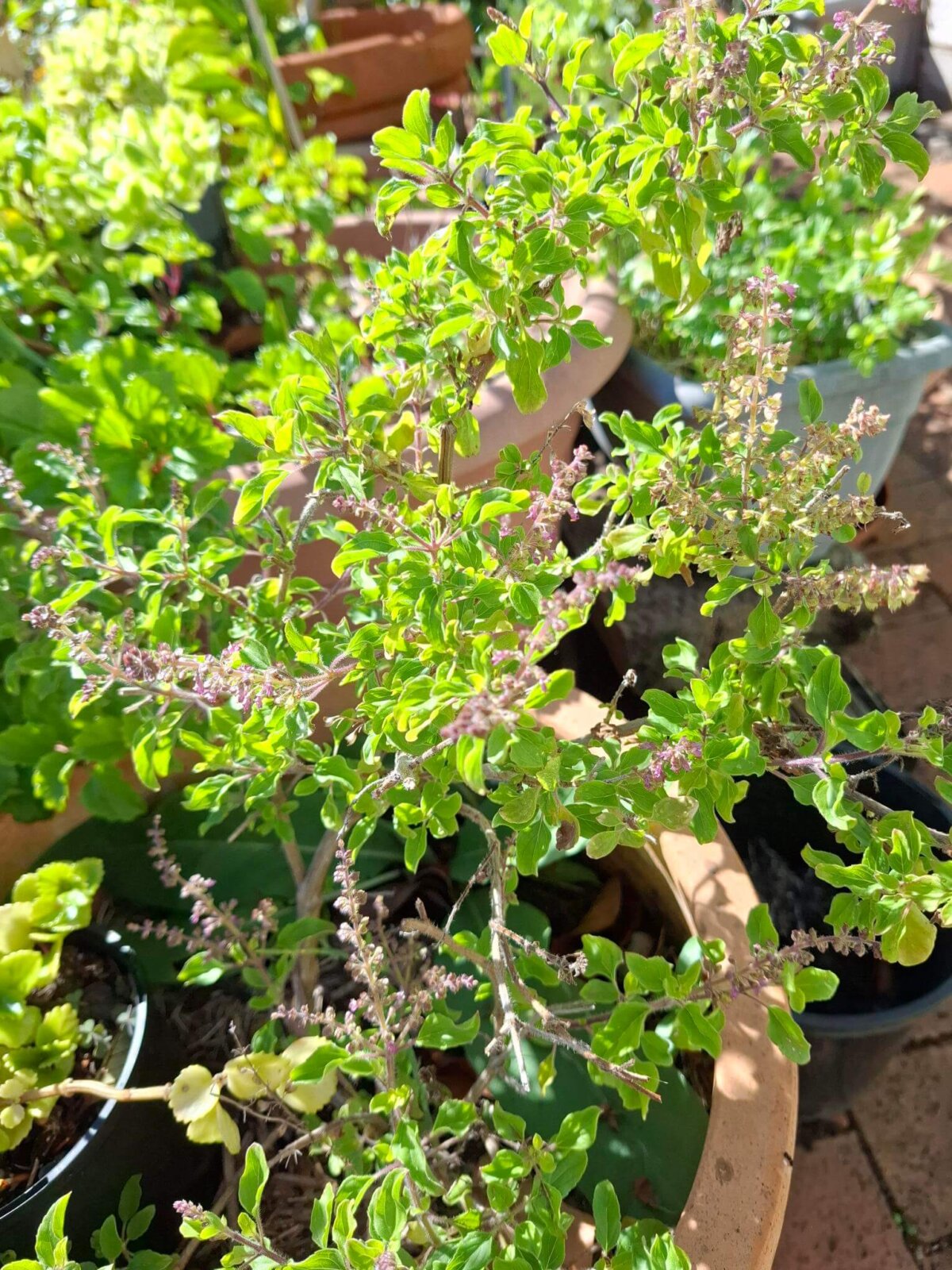
Holy basil growing in my garden in Sydney, Australia
I use the fresh leaves and flowers in herbal teas, eat a few leaves fresh or add them to salads.
Holy basil can be propagated from seed or cuttings and prefers warmth and plenty of sunlight – it won’t grow in shade. It’s an attractive perennial plant in warm climates.
How Is Holy Basil Used?
Holy basil is available in several different forms, including:
- Dried holy basil or Tulsi tea
- Dried herb
- Liquid herbal extracts and tinctures
- Capsules and tablets
- Standardised extracts
These preparations are not necessarily equivalent. A concentrated extract cannot automatically be compared milligram-for-milligram with dried herb, tea or another extract. Different products may also contain different plant parts and extraction ratios. This is one reason dosage information found online can be confusing.
Holy Basil Dosage and the Best Time to Take It
There is no single evidence-based dose of holy basil that is appropriate for everyone.
Human clinical studies have used different preparations and widely varying doses. For example, one recent stress trial used 125 mg of a particular standardised extract twice daily [2], while earlier studies have used substantially larger amounts of other preparations. [1]
This doesn’t mean that one study found a “better” dose. It means that the preparation matters. The appropriate amount depends on the form of holy basil, its concentration, why it is being used, other herbs or medicines being taken and the individual person.
There is also insufficient evidence to say that holy basil has one universally “best” time of day. In practice, timing may depend on why it is being prescribed, how the individual responds and what other herbs are included in the formula. Follow the directions for a reputable product or, when using holy basil therapeutically, seek advice from a qualified herbal practitioner.
Is Holy Basil Safe?
Holy basil has generally been well tolerated in the human clinical studies conducted so far, but that doesn’t mean it is appropriate for everybody or that unlimited long-term use has been proven safe. Reported adverse effects in clinical research have generally been uncommon and mild, but comprehensive long-term human safety data remain limited.
Pregnancy and breastfeeding require particular caution because adequate human safety information is lacking. Because holy basil may influence blood glucose, people taking glucose-lowering medication should also seek professional advice before using therapeutic amounts.
Holy Basil Interactions and Precautions
Potential interactions are another reason to treat medicinal herbs with the same respect we give other biologically active medicines. Particular caution may be appropriate for people taking:
- Anticoagulant or antiplatelet medication
- Blood-glucose-lowering medication
- Sedative medication including barbiturates
- Other regular prescription medicines where a potential herbal interaction has not been assessed
As a precaution, holy basil is generally best discontinued before elective surgery. Discuss timing with your surgeon, doctor or herbal practitioner, particularly because of its potential effects on blood clotting and blood glucose. Some reported interactions remain theoretical or are based primarily on laboratory or animal research rather than demonstrated clinical interactions in humans.
That uncertainty doesn’t mean we should assume there is no risk. If you take regular medication, have a medical condition, are pregnant or breastfeeding, or are considering therapeutic doses of holy basil, discuss its suitability with your doctor, pharmacist or appropriately qualified herbal practitioner.
Key Takeaways
Holy basil, or Tulsi, is a highly regarded Ayurvedic medicinal herb with a long traditional history and growing modern research interest.
Modern clinical research is strongest for its role in stress and stress resilience, while anxiety remains an important traditional and clinical indication when the person’s overall presentation is appropriate. Holy basil may also be useful when stress contributes to fatigue or disrupted sleep, and it can have a place during perimenopause and menopause when these patterns are present.
Modern clinical research is promising, but still developing. It should complement rather than replace the accumulated knowledge of traditional medicine and thoughtful clinical herbal practice. Most importantly, medicinal herbs are not simply products matched to symptoms.
The right herb, dose, preparation and combination depend on the person.
Continue Exploring Herbal Medicine
If you’d like to learn more about medicinal herbs, their traditional uses and what modern research is discovering about them, visit the Naturimedica Herbal Medicine Resources Hub. [9]
You may also find these resources helpful:
- Nutrition for Good Mental Health [10]
- Sleep and Circadian Health Knowledge Hub [11]
- Menopause Knowledge Hub [12]
- The Naturimedica Way [13]
If you would like individual support with stress, anxiety, sleep, fatigue, menopause or other interconnected health concerns, you can also learn more about Online Naturopathic Consultations Australia. [14] Naturimedica consultations are available online Australia-wide.
Please note that this article is for educational purposes only and is not intended as a substitute for individual medical advice, diagnosis or treatment. Medicinal herbs can have physiological effects and may interact with medicines. Seek appropriate professional advice for your individual circumstances.
Best of Health
Joanna Sochan
Wholistic Health and Lifestyle Therapist
Integrative health support combining clinical evidence, systems-based thinking and traditional naturopathic wisdom for lasting health and wellbeing
Additional Resources
- Metabolic Health After 40 [5]
- Stress and Cortisol articles [15]
- Lemon Balm For Insomnia, Memory, Anxiety and Skin [16]
- Metabolic Health Reset Guide & Workbook [17]
References
Bhattacharyya D, Sur TK, Jana U, Debnath PK. Controlled programmed trial of Ocimum sanctum leaf on generalized anxiety disorders. Nepal Medical College Journal. 2008;10(3):176–179.
https://pubmed.ncbi.nlm.nih.gov/19253862/ [4]
Dharmani P, Kuchibhotla VK, Maurya R, Srivastava S, Sharma S, Palit G. Evaluation of anti-ulcerogenic and ulcer-healing properties of Ocimum sanctum Linn. Journal of Ethnopharmacology. 2004;93(2–3):197–206.
https://pubmed.ncbi.nlm.nih.gov/15234753/ [18]
Goel RK, Sairam K, Dorababu M, Prabha T, Rao CV. Effect of standardized extract of Ocimum sanctum Linn. on gastric mucosal offensive and defensive factors. Indian Journal of Experimental Biology. 2005;43(8):715–721.
https://pubmed.ncbi.nlm.nih.gov/16121713/ [19]
Jamshidi N, Cohen MM. The clinical efficacy and safety of Tulsi in humans: a systematic review of the literature. Evidence-Based Complementary and Alternative Medicine. 2017;2017:9217567.
https://pubmed.ncbi.nlm.nih.gov/28400848/ [6]
Lopresti AL, Smith SJ, Metse AP, Drummond PD. A randomized, double-blind, placebo-controlled trial investigating the effects of an Ocimum tenuiflorum (Holy Basil) extract on stress, mood, and sleep in adults experiencing stress. Frontiers in Nutrition. 2022;9:965130.
https://pubmed.ncbi.nlm.nih.gov/36185698/ [2]
Plants For A Future. Ocimum tenuiflorum L. Plants For A Future. c. 2010–2022.
https://pfaf.org/user/Plant.aspx?LatinName=Ocimum+tenuiflorum [20]
Richard EJ, Illuri R, Bethapudi B, Anandhakumar S, Bhaskar A, Chinampudur Velusami C, Mundkinajeddu D, Agarwal A. Anti-stress activity of Ocimum sanctum: possible effects on hypothalamic-pituitary-adrenal axis. Phytotherapy Research. 2016. doi:10.1002/ptr.5584.
https://pubmed.ncbi.nlm.nih.gov/26899341/ [3]
Saxena RC, Singh R, Kumar P, Negi MPS, Saxena VS, Geetharani P, Allan JJ, Venkateshwarlu K. Efficacy of an extract of Ocimum tenuiflorum (OciBest) in the management of general stress: a double-blind, placebo-controlled study. Evidence-Based Complementary and Alternative Medicine. 2012;2012:894509.
https://pubmed.ncbi.nlm.nih.gov/21977056/ [1]
Singh S, Majumdar DK. Evaluation of the gastric antiulcer activity of fixed oil of Ocimum sanctum (Holy Basil). Journal of Ethnopharmacology. 1999;65(1):13–19.
https://pubmed.ncbi.nlm.nih.gov/10350365/ [8]
Disclaimer: This content is for informational and educational purposes only and is not intended to diagnose, treat, cure, or prevent any disease. It is not a substitute for professional medical advice, diagnosis, or treatment. Always consult a qualified healthcare provider before making any changes to your health regimen, particularly if you are taking prescription or over-the-counter medications or have a medical condition.
Bio: Joanna Sochan is a Wholistic Natural Therapist and founder of Naturimedica Wholistic Wellcare. She has over 15 years of clinical experience working with complex health presentations, with a focus on gut health, women’s hormone health (including perimenopause and menopause), metabolic health, weight regulation, and circadian biology. She works with clients Australia-wide and online, and also develops therapeutic programs, eCourses, and educational resources designed to support long-term, sustainable wellbeing. View full bio [21].