Eating with the seasons sounds like a simple idea: enjoy tomatoes and berries in summer, pumpkins and root vegetables in autumn and winter, and the fresh greens and vegetables that arrive with spring.
For most of human history, this was not a lifestyle choice. It was simply how people ate. What was available depended on where you lived, the time of year, rainfall, temperature, daylight and what could be grown, gathered, hunted, stored or preserved. Food changed as the environment changed.
Today, much of that connection has disappeared. Global transport, refrigeration, protected cropping such as greenhouses or polytunnels allow us to buy many foods throughout the year. A supermarket in the middle of an Australian winter can look remarkably similar to the same supermarket in summer.
There are enormous advantages to this. Modern food systems give us reliable access to nutritious foods, protect us from many of the shortages experienced by previous generations and allow us to enjoy foods that would never grow in our own climate. But something interesting has happened at the same time. Food has become increasingly separated from time and place. And that raises a question I think is worth exploring. Food does not exist separately from the environment in which it grows, and neither do we.
Plants respond continuously to their surroundings. Light, darkness, day length, temperature, water, soil and environmental stress all influence how a plant grows and aspects of the chemistry it produces. Humans also respond to our environment. Our circadian rhythms [1]are strongly influenced by light and darkness. Sleep, hormones, metabolism, appetite, immune activity and behaviour all interact with biological timing. We also retain evidence of seasonal rhythms, although modern humans are far less constrained by the seasons than our ancestors were.
So perhaps eating with the seasons deserves a broader conversation than whether seasonal strawberries taste better (they do!) or locally grown vegetables have travelled fewer kilometres. At the heart of this article is a simple chain:
- Nature influences plants
- Plants become food
- Food influences us
- Nature changes with time and place
How much of that information travels through the whole chain?
Modern science can answer parts of that question surprisingly well. Traditional cultures observed other parts long before we had laboratories to measure them. And emerging fields including chronobiology, plant science and quantum biology are beginning to raise some fascinating new questions of their own.
Some answers are well established. Others are intriguing but still developing. And some take us right to the edge of what we currently understand. That is where this exploration of eating with the seasons begins.
Quick Summary
Eating with the seasons is usually discussed in terms of freshness, flavour, nutrition and sustainability. But there may be a deeper story.
Humans live within daily and seasonal biological rhythms. Plants also respond continuously to light, temperature, water, soil and other environmental signals, and these conditions can influence the food they eventually become.
This article explores what established science, traditional knowledge and emerging research can tell us about the relationship between food, time and place, including seasonal changes in the human microbiome, plant responses to their growing environment, food provenance (where food comes from and how it was produced), lunar biology and emerging research into deuterium and biophysics.
The practical message is simple: Let the seasons influence your diet rather than dictate it.
Key Definitions
Allowing foods naturally available at different times of year to influence what you eat.
Food grown during its natural season within your own climatic region.
An approximately 24-hour biological rhythm that helps coordinate sleep, hormones, metabolism and many other physiological processes and is strongly influenced by the daily light-dark cycle.
A biological rhythm occurring across approximately one year, often influenced by seasonal environmental changes.
The duration of light and darkness across a 24-hour day. Photoperiod changes naturally with the seasons.
An interdisciplinary field investigating how quantum phenomena at the atomic and subatomic level may contribute to biological processes. Research includes areas such as photosynthesis, enzyme reactions and magneto reception, the biological ability to perceive magnetic fields, allowing organisms to detect the Earth’s magnetic field for orientation and navigation.
A naturally occurring heavier isotope of hydrogen found in water, food and the human body.
What Does Eating With the Seasons Mean?
At its simplest, seasonal eating means allowing foods that are naturally available at different times of year to have a greater influence on what we eat.
That does not mean eating only locally grown food or refusing anything that is out of season. It is also useful to distinguish between seasonal and locally seasonal food. A mango grown naturally during mango season in Queensland is seasonal where it was produced. If it is transported somewhere experiencing a very different climate or season, however, it is not locally seasonal for the person eating it.
That distinction becomes particularly interesting when we start thinking about food not only as a collection of nutrients, but as something produced within a particular time and place.
For practical purposes, seasonal eating can be much simpler. It might mean noticing which vegetables suddenly become abundant at your local growers market, changing some of the plants you eat through the year, enjoying more fresh salads and water-rich foods in warmer weather, and naturally gravitating towards soups, stews, roasted vegetables and warming foods as temperatures fall.
Today, the seasons influence the diet rather than dictate it.
What are the health benefits of eating seasonally?
The usual arguments for seasonal eating are sensible ones.
Produce harvested closer to natural maturity may offer better flavour and, depending on the food and how it has been handled, better retention of some nutrients. Seasonal produce can be more plentiful and affordable. Changing what we eat throughout the year can also encourage greater dietary variety rather than relying on the same ten or fifteen foods week after week.
But from a wholistic health perspective, another benefit particularly interests me: diversity across time.
We often talk about eating a diverse range of plants to support the gut microbiome. [2] But what if diversity is not only about how many different plants we eat? What if it also matters that the plants available to us naturally change through the year?
A seasonal microbiome?
This was one of the findings that made me stop while researching this article.
Researchers studying Hutterite farming communities in South Dakota, USA, sampled the gut microbiomes of the same 60 people during winter and summer. The communities live and eat communally, with meals prepared using traditional recipes and much of their fresh produce grown within the colonies. This created an unusual natural experiment: much of the diet remained relatively consistent, while fresh fruit and vegetable consumption changed considerably with the seasons.
The researchers found significant seasonal changes in the gut microbiome. [3] Fresh fruit and vegetable intake also varied considerably between winter and summer, and the researchers considered seasonal food availability one likely contributor, while recognising that other environmental factors also changed with the seasons. This does not mean that eating imported strawberries in winter will harm your microbiome, or that we should try to engineer a particular “summer” or “winter” microbiome.
It suggests something more interesting. Our internal ecosystem may be more responsive to the changing external environment than we usually consider.
The foods we eat influence which microorganisms are fed and which metabolites they produce. If the plants in our diet naturally change across the year, the nutritional and phytochemical environment reaching our gut changes too. So perhaps there are two useful ways to think about plant diversity: [4]
- Diversity across the plate: eating many different plants.
- Diversity across the year: allowing at least some of those plants to change with the seasons.
Neither requires perfection.
Frozen vegetables, tinned tomatoes, frozen berries and foods transported from other regions can all form part of a nutritious diet. Seasonal eating should not become another restrictive set of food rules. Instead, it can be an invitation to notice something modern life makes very easy to overlook: What is Nature producing around me now?
And once we ask that question, another naturally follows. If plants change with the seasons, do we?
That takes us to one of the most fascinating parts of this story: the biological clocks that help the body recognise not only what time of day it is, but potentially what time of year it is.
Your Body Has More Than One Biological Clock
You may already be familiar with the idea of the body’s circadian clock. Located in the brain, the master clock helps coordinate our daily rhythms in response to environmental signals, particularly light and darkness. In 2017, the Nobel Prize in Physiology or Medicine was awarded for discoveries explaining the molecular mechanisms that help biological clocks keep time.
Our circadian rhythm helps coordinate physiology across approximately 24 hours. Light in the morning, daylight during the day, darkness at night, food timing, movement and sleep all provide information that helps the body organise itself in time. But there is another layer of biological timing that receives much less attention. The body also lives within the changing rhythm of the year.
We can think of these as two interconnected clocks:
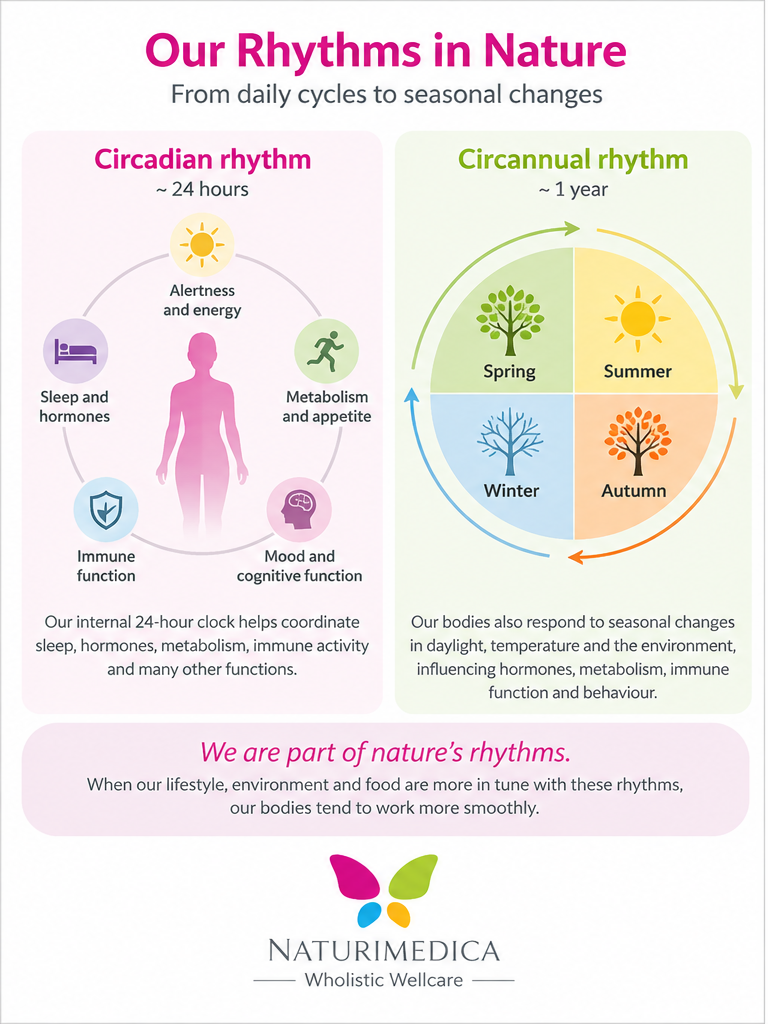
Light provides important information to both.
The daily cycle of light and darkness helps synchronise our circadian system. Across the year, however, the length of that light-dark cycle changes. Summer brings longer days and shorter nights. Winter brings shorter days and longer nights. This changing photoperiod [5], the biological term for day length, is one of Nature’s most reliable indicators of season.
In strongly seasonal animals, photoperiod can trigger profound changes in reproduction, appetite, body weight, coat growth, migration and energy metabolism. Human seasonality is much less pronounced and varies considerably between individuals and environments, but it has not disappeared.
Studies have identified seasonal variation in human sleep, activity, immune function, hormone patterns, gene expression and other aspects of physiology. One large study examining blood and adipose tissue found seasonal expression patterns in thousands of human genes. Interestingly, some of those patterns were reversed between people living in Europe and Oceania, where the seasons occur at opposite times of year.
We may have insulated ourselves remarkably well from the seasons, but our biology has not become completely seasonless.
Melatonin tells us more than when to sleep
One finding I found particularly fascinating involves melatonin.
We usually think of melatonin as our “sleep hormone”, although its role is much broader than sleep. Melatonin is fundamentally a signal of biological darkness. [6]As evening light fades and darkness arrives, melatonin normally rises. Morning light [7]helps bring that nocturnal signal to an end. But the duration of darkness changes across the year.
In a classic experiment, researchers exposed healthy people to artificial light-dark cycles designed to mimic shorter summer nights and longer winter nights. Under the winter-like conditions, the participants’ nocturnal melatonin secretion lasted significantly longer. In other words, melatonin may carry information not only about: Is it night? but also: How long is the night? That gives the body potential information about time of year as well as time of day. [8]
Other human studies have not always found the same degree of seasonal change, particularly under ordinary modern living conditions. Latitude, artificial lighting, individual responsiveness and time spent indoors may all influence how strongly seasonal signals are expressed. This is an important distinction. Humans are not simply programmed by photoperiod in the way that many strongly seasonal animals are.
But it does raise a fascinating possibility: by extending our days with artificial light and spending much of our lives in temperature-controlled indoor environments, we may be reducing some of the environmental contrasts that historically distinguished one season from another.
When the signals of season travelled together
For most of human history, seasonal information did not arrive through one signal alone. As the year changed:
- Day length changed
- Temperature changed
- Plants changed
- Food availability changed
- Activity changed
- Food preparation changed
These signals tended to tell a broadly consistent environmental story. A long, warm summer day came with one set of foods and activities. A short, cold winter day came with another. Modern life allows us to separate those signals in ways that would once have been impossible.
We can experience short winter daylight while living in a house heated to summer temperatures. We can extend the evening with artificial light. We can eat late into the night. And our food can arrive from a different climate, latitude, hemisphere or season.
That does not make modern life inherently unhealthy. Heating, refrigeration, lighting, protected agriculture and global food distribution have brought enormous benefits. But biologically, something has changed: signals that historically tended to move together can now become uncoupled.
We do not yet know the full significance of that change for human health. Circadian disruption [9] itself is well established as relevant to health, while the consequences of losing broader seasonal alignment are much less certain. That distinction matters.
The point is not that we should recreate ancestral living or force ourselves into a rigid seasonal regime. It is simply to recognise that time is part of our biological environment. And food exists within that environment too. Which brings us to a phrase frequently used in nutrition, but rarely explored very deeply.
Food as Information: What Does That Really Mean?
“Food is information” sounds appealing, but what does it actually mean?
At the most familiar level, it is quite literal. When we eat, food does much more than provide calories. Carbohydrates, fats and proteins influence hormones and metabolic pathways [10]. Fibre interacts with the gut microbiome. Vitamins and minerals participate in thousands of biochemical reactions. Plant phytochemicals interact with cellular signalling, antioxidant defence, inflammation and other physiological processes. Food composition therefore changes the biochemical environment inside us.
But there is another side to this story that is easy to overlook. Before food provides information to us, the plant itself has been receiving information from its environment.
A plant is constantly reading its environment. Plants cannot move away when their environment changes. Instead, they adapt.
They detect light intensity and different wavelengths of light. They respond to the length of the day, temperature, water availability, soil conditions, physical stress and interactions with other organisms. These environmental conditions can influence not only how quickly a plant grows or how large it becomes, but also aspects of its internal chemistry.
Plants produce an extraordinary range of compounds, including polyphenols, flavonoids, carotenoids, terpenes, alkaloids and many others. Some help protect the plant from ultraviolet radiation. Others participate in defence against pests, attract pollinators, provide colour or help the plant respond to environmental stress. Many of those same compounds become part of our food.
This relationship is particularly familiar in herbal medicine. The growing location, soil, climate, harvest time and plant part can all influence the chemical profile of a medicinal herb. A plant is not simply a genetically predetermined container waiting to be harvested. Its environment helps shape what it becomes.
Practitioner Insight
Why Growing Conditions Matter in Herbal Medicine
One example has stayed with me since I studied herbal medicine: Tribulus terrestris. Research comparing plants from different geographical regions has found substantial differences in their steroidal saponin profiles, including protodioscin, one of the constituents commonly used when standardising Tribulus extracts.
Bulgarian Tribulus became particularly well known for its characteristic phytochemical profile, but the broader lesson is more important than this one herb. Two plants can carry the same botanical name and still differ chemically according to where they grew, which plant parts were harvested and how they were processed and extracted. It was an early reminder for me that with herbal medicine, the name of the plant does not tell you everything about the medicine inside it.
Read the research comparing plants from different geographical regions [11]. You can also read my article Tribulus: A special herb for reproduction and fertility for both men and women. [12]
The same principle applies to food plants. Food is produced within an environment. That environment influences the plant. The plant becomes part of our internal environment when we eat it.
Does sunlight change the food itself?
This question becomes particularly interesting when we compare plants grown outdoors with those grown in controlled environments.
Modern greenhouse and indoor agriculture can precisely manipulate temperature, water, nutrients and light. LED lighting can even be designed to increase particular desirable compounds in plants. And it works. Researchers have shown that particular light wavelengths and growing conditions can increase selected phytochemicals such as anthocyanins, carotenoids and phenolic compounds. But there is another side to the story.
Studies comparing open-field and controlled-environment plants have also found differences in their broader chemical profiles. Research on spinach, [13] for example, has identified distinct metabolite and phytochemical patterns according to how and where the plants were grown. That does not mean outdoor-grown food is automatically “better”, nor that greenhouse or LED-grown food is somehow incompatible with human biology. We simply do not have evidence for such a conclusion at this time.
It does, however, reveal an important limitation in the way we sometimes think about nutritional quality. If an LED treatment increases one beneficial phytochemical by 30%, have we necessarily made the whole food 30% better? Probably not.
A plant contains hundreds, often thousands, of interacting compounds. Increasing one measurable component tells us something about that component. It does not necessarily tell us what has happened to the whole biochemical pattern of the plant, or whether every difference matters to the person who eventually eats it.
This is where reductionist nutrition and wholistic thinking ask slightly different questions.
One asks: How much vitamin C, carotenoid or anthocyanin does this food contain?
The other also asks: What kind of plant produced it, and within what environment?
Both questions can be useful.
Information does not begin when food reaches our plate
This is one of the ideas that deepened my own understanding while researching this article. When we say that “food is information”, we usually begin the story when food enters the body. But perhaps that begins too late. There is information before the plate.
- Light influenced the plant
- Day length influenced the plant
- Temperature and water influenced the plant
- Soil and growing conditions influenced the plant
- The plant responded through its own biology
- And then we eat the result
That gives us a simple pathway: ENVIRONMENT → PLANT → FOOD → HUMAN BIOLOGY
We understand some parts of that pathway very well. Other parts are only beginning to come into focus. And one of the most surprising examples comes from something as common as water – water can carry information about place.
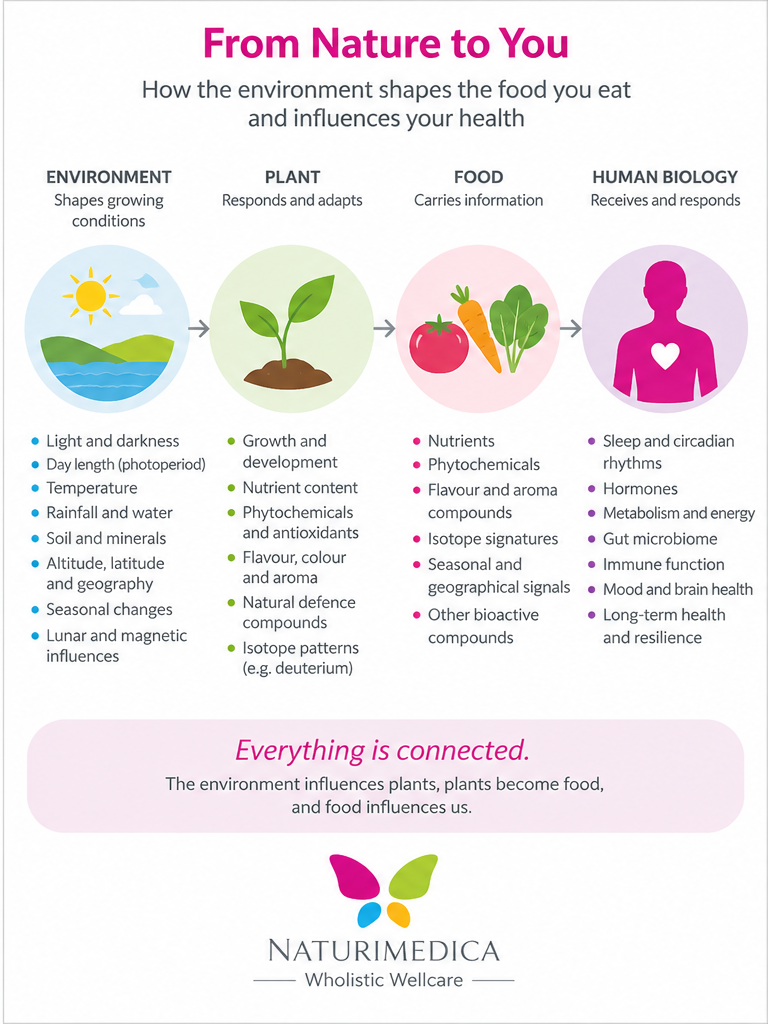
The environment influences the plant. The plant becomes part of our internal environment when we eat it.
Does Where Your Food Grows Matter?
If season tells us when, locality introduces another question: Where? The two are related, but they are not the same.
A food can be seasonal where it was grown but eaten somewhere experiencing an entirely different season. Modern transport makes it possible for us to eat foods grown thousands of kilometres away, under different temperatures, rainfall patterns, day lengths and climatic conditions. Again, this is not necessarily a problem. Global food distribution gives us extraordinary dietary variety and improves access to nutritious food throughout the year.
But if we are exploring food as information, place becomes interesting. Local food is about more than food miles.
The usual conversation about local food tends to focus on transport and environmental impact. That matters, but even here the story is more complicated than “local is always better”. How a food is produced can sometimes have a greater environmental impact than how far it travels. A crop grown naturally outdoors and transported some distance may, in some circumstances, require fewer resources than the same crop produced locally in a heavily heated or controlled environment.
There are also nutritional considerations. Time between harvest and eating can affect some nutrients, particularly those that are relatively sensitive to storage. Harvest maturity, cultivar (a cultivated variety of a plant), temperature and storage conditions also matter.
But our research led us to another aspect of locality that receives much less attention. The environment can leave measurable clues inside the food itself. Food can carry a chemical signature of place
This was another of those moments in researching this article when I stopped and thought: how fascinating.
To start with, water is not chemically identical everywhere. The natural ratios of stable isotopes [14] in water vary with geography and climate, including factors such as latitude, altitude, temperature and distance from the coast. Plants take up water from their environment, and their own biology further shapes the isotope patterns found within plant tissues and compounds.
These differences can be measurable enough that scientists use stable isotope analysis to help determine the geographical origin of foods and beverages [15]. In other words: Place can leave a measurable signature in food.
That does not mean a strawberry carries a little biochemical postcode telling your body that it came from Tasmania rather than Queensland. But it gives genuine scientific substance to an idea that otherwise sounds rather abstract: food can retain measurable information about the environment in which it was produced.
And it raises a much more adventurous question. Whether human biology can also use aspects of that information as a signal of place or season is an intriguing possibility that has not yet been established.
What Did Traditional Cultures Notice Before We Had Laboratories?
Modern nutrition often begins with the composition of food. How much protein does it contain? How much carbohydrate? Which vitamins and minerals? How much fibre?
Traditional food and medical systems often looked at food through a wider lens. They observed the person eating the food, the environment in which that person lived and the time of year.
Across different traditions, foods were selected, prepared and combined differently according to climate, season, life stage and individual constitution. These systems did not use the language of circadian biology, metabolomics (the study of the small molecules produced during metabolism) or nutritional biochemistry. They developed through accumulated observation and experience over generations.
That does not mean every traditional practice is biologically correct. Nor should we try to make traditional concepts sound more scientific by retrofitting a modern mechanism onto them. But neither should we dismiss centuries of empirical observation simply because it developed before the laboratory.
Warming foods, cooling foods and changing seasons
Traditional Chinese Medicine provides a familiar example. Foods have historically been described not only by flavour or nutrient content but by qualities such as warming and cooling. [16]These descriptions are not simply a reference to the temperature at which a food is served.
Watermelon is traditionally considered strongly cooling. And without needing to prove a molecular mechanism, there is something intuitively coherent about watermelon as a summer food. It grows in warm conditions. It is rich in water. It is refreshing and light. A slice of watermelon on a hot summer afternoon feels entirely different from eating the same food on a cold winter morning.
Traditional systems paid attention to those relationships. During colder periods, foods and preparation methods commonly shift towards warming, cooked meals: soups, broths, stews, roasted vegetables, roots, grains, legumes and warming herbs and spices. During warmer periods, diets can naturally include more fresh, water-rich foods and lighter preparation.
Ayurveda developed an especially detailed seasonal framework known as Ritucharya [17], in which food, activity and daily routines change as environmental conditions change through the year.
Japanese food culture offers another beautiful concept: shun, enjoying a food at the point in its season when it is considered to be at its best. Traditional Japanese thinking goes even further [18], recognising foods as they first arrive, at their seasonal peak and as their season begins to pass.
These traditions differ enormously, and we should not assume they all describe the same biological system. What they share is something more fundamental: Food was understood within a relationship between person, place and time.
Preparation changed with the seasons too
Seasonal eating was never only about which plants were available. People also changed what they did with them.
Foods were dried, fermented, salted and preserved when they were abundant. Winter foods were simmered and stewed. Roots and stored vegetables became more important when fresh summer produce disappeared. Herbs and spices changed how foods tasted and were traditionally understood to affect their qualities.
These practices served obvious practical purposes, including preserving food through periods when little grew. But they also changed the food itself. Cooking alters digestibility and food structure. Fermentation [2] transforms carbohydrates and creates new metabolites. Sprouting changes nutrient availability. Preservation allows the products of one season to support people through another.
So traditional seasonal eating was never as simple as: Only eat what is growing outside today.
Humans have always found ingenious ways of carrying food from one season into another. That is another reason I don’t think seasonal eating should become a rigid modern rule. The more interesting lesson is that food traditions maintained an awareness of season, even when they were preserving food beyond it.
Tradition is evidence, but it is a different kind of evidence
This distinction is important throughout this article. A practice repeated for hundreds or thousands of years is not equivalent to a randomised controlled trial. But a randomised controlled trial is not the only way human beings have learned about their environment either.
Traditional and empirical knowledge can identify patterns worth preserving and investigating. Modern science can test particular observations, measure mechanisms and sometimes challenge assumptions that have been carried forward unquestioned.
Occasionally, something especially interesting happens: modern science begins investigating a phenomenon that traditional cultures had been observing all along. The relationship between plants and the Moon may be one such example.
The Moon: Another Rhythm Nature Has Not Forgotten
For generations, farmers and gardeners in many cultures have planted, pruned and harvested with reference to phases of the Moon.
For people who have worked closely with the land, this is not an exotic idea. It is part of accumulated agricultural knowledge. Modern agricultural science has generally been much more sceptical. Reviews have pointed out, reasonably, that evidence supporting specific lunar planting calendars is inconsistent and that many traditional claims have not been demonstrated experimentally.
That remains true. But another question is now being investigated: Can plants detect and respond to the Moon at all?
A small but intriguing body of experimental research suggests that they can.
Plants respond to moonlight
In one study, researchers examined coffee plants exposed to natural full moonlight [19]and found changes in the expression of thousands of genes, including genes involved in the plants’ circadian clock. Think about that for a moment. Moonlight is extremely faint compared with daylight, yet the plants were not biologically indifferent to it.
Another experiment exposing mustard and tobacco plants to natural full moonlight reported changes in cellular organisation, DNA methylation, proteins and primary metabolites. Changes in early growth were also observed in mustard.
These findings do not prove that every traditional lunar planting or harvesting rule is correct. But they challenge another assumption: that moonlight is simply too weak to be biologically meaningful to plants.
Recent plant-science reviews are now calling for the subject to be investigated more seriously [20]. Once again, the interesting position lies between the extremes. We do not need to say: Traditional lunar agriculture has now been scientifically proven. It hasn’t so far.
But neither is it reasonable to assume: Plants could not possibly respond to lunar light. Experimental research now shows that plants can respond to natural moonlight.
What about us?
Human research is less consistent, but intriguing observations also exist.
Controlled studies and field research have reported associations between lunar phase and aspects of sleep [21], including sleep duration and timing. Some studies have reported changes in melatonin, while research into menstrual cycles has found periods of temporary synchronisation with lunar rhythms in some women.
Other studies have failed to find consistent effects. So this remains an emerging and contested area rather than an established part of human chronobiology. But perhaps that is enough for our purposes.
The daily rising and setting of the Sun is not Nature’s only rhythm. The year has a rhythm. The Moon has a rhythm. Weather and temperature have rhythms. The Earth’s magnetic environment also varies, and researchers continue to investigate whether and how living organisms detect such changes.
We are only beginning to understand which of these environmental rhythms matter biologically, how much they matter, and to which organisms. For this article, we do not need to resolve those questions. It is enough to recognise something we can easily forget when food arrives clean, packaged and brightly lit on a supermarket shelf: A plant grows within an environment full of changing information.
And some of that information may travel further through the food chain than we currently understand. That brings us to the frontier of our discussion.
What Might Quantum Biology and Emerging Biophysics Add to the Picture?
We have travelled quite a long way from the simple advice to “eat more seasonal vegetables”. But there is one more layer worth exploring.
Quantum biology [22] investigates situations where processes occurring at the scale of atoms and subatomic particles may contribute to biological function. This is a legitimate and developing field of science, although the term is sometimes used much more loosely in popular health discussions.
Photosynthesis [23] is one of the reasons biologists became interested in this area. Other research investigates phenomena such as electron and proton transfer, enzyme reactions, magnetoreception and the behaviour of isotopes within living systems. For our seasonal food story, one isotope is particularly interesting.
Deuterium: when hydrogen gets heavier
A little science to start with: Most hydrogen atoms contain a single proton. A small proportion also contain a neutron. This heavier, naturally occurring form of hydrogen is called deuterium [24]. Deuterium is not a toxin or an artificial contaminant. It occurs naturally in water, food and our bodies.
But because a deuterium atom is approximately twice the mass of ordinary hydrogen, chemical bonds involving it can behave differently. This is known as an isotope effect. And that matters because hydrogen is everywhere in biology. It is present in water, carbohydrates, fats and proteins and participates in many biochemical reactions. Researchers have therefore been asking whether naturally occurring differences in deuterium might influence cellular metabolism, particularly within the mitochondria. [10]
Why mitochondria enter the story
Mitochondria generate much of our cellular energy through a remarkable series of reactions involving the movement of electrons and protons.
At the end of this process sits ATP synthase, a tiny molecular machine embedded within the mitochondrial membrane. The flow of protons through ATP synthase helps drive the production of ATP, a molecule cells use to transfer energy for countless biological processes. But mitochondria are much more than cellular power stations. They also participate in signalling, redox balance, calcium regulation, heat production and many other processes that help cells sense and respond to their environment.
Because deuterium behaves differently from ordinary hydrogen, researchers have proposed that replacing a proton with the heavier deuterium isotope could alter some proton-dependent reactions. The isotope chemistry itself is well established. Exactly how important naturally occurring variations in deuterium are to mitochondrial function and human health is much less certain. Experimental and theoretical work has investigated possible effects on ATP synthase and proton-coupled reactions, but translating this into everyday human nutrition remains a substantial scientific step.
This distinction becomes especially important because claims about deuterium have moved considerably faster in some nutrition circles than the clinical evidence.
A 2024 scoping review investigating nutritional deuterium depletion (the process of reducing the levels of deuterium, a heavy isotope of hydrogen, in the body through dietary changes, such as consuming low-deuterium foods and drinking deuterium-depleted water) found only 15 eligible studies, which were heterogeneous and included both human and animal research. The authors concluded that the subject warrants further investigation and specifically called for more randomised controlled trials. One of the review authors, László Boros, is affiliated with the Deutenomics Science Institute, which is also relevant context when considering how mature and independently replicated this field currently is.
So there is interesting biology here. There is not yet a reason to turn deuterium into another nutrient we need to micromanage.
Could food carry another environmental signature?
This brings us back to our original question. We already know that the deuterium content of environmental water varies geographically. Plants incorporate hydrogen from water and through their metabolism, while different biochemical pathways can produce different isotope patterns within plant carbohydrates, fats and other compounds.
When we eat those foods, those hydrogen isotopes enter our metabolism too. Some researchers and practitioners working at the intersection of mitochondrial physiology and quantum biology have proposed that these relationships could have broader implications for food choice, mitochondrial function, latitude and season.
This is where we need to separate an interesting hypothesis from an established nutritional principle. The chain begins with some solid science:
Environmental water varies in its isotope composition → Plants incorporate and alter those isotopes through metabolism → Foods therefore differ in their isotope composition → Hydrogen isotope effects can influence biochemical reactions
The next step is much less certain: Does eating foods with particular natural deuterium patterns help human metabolism remain aligned with a particular place or season? We do not yet know.
That final arrow is precisely where established chemistry becomes an emerging biological hypothesis. And I think that makes the question more interesting, not less. We don’t need to fill the gap with certainty simply because the idea is compelling. This is a good example of how I think emerging research should be approached: notice it, investigate it, keep asking questions, but don’t ask the evidence to say more than it does.
And there may be other environmental signals
Deuterium is not the only frontier. Researchers are also investigating whether biological systems respond to subtle changes in natural magnetic fields. Cryptochromes, the light-sensitive proteins involved in circadian biology, are among the mechanisms being studied in relation to magnetoreception.
Evidence is much stronger in some animals than in humans, and human magnetoreception remains unresolved at this time. For our purposes, we don’t need another rabbit hole. The broader point is enough: Life evolved within an environment containing multiple rhythmic signals, not simply nutrients and calories.
- Light changes
- Temperature changes
- Food changes
- Water changes
- The Moon changes
- The geomagnetic environment changes
And living organisms have evolved while all of those things were happening together.
Which brings us back to the much more practical question that matters when standing in front of the fridge: Does any of this mean we should only eat local, seasonal food?
Not quite. And this is where I think seasonal eating becomes both simpler and more useful.
So, Should You Only Eat Local, Seasonal Food?
It would be easy to reach the end of this exploration and conclude that the answer is to eat only food grown locally and naturally in season. I don’t think the current evidence supports that conclusion. Nor do I think it would necessarily produce a healthier diet.
Frozen berries in winter can be highly nutritious. Tinned tomatoes are enormously useful. Frozen vegetables make healthy eating [25] easier. Olive oil, spices, tea, coffee, nuts and many other foods may come from climates very different from our own. Modern agriculture and food distribution allow Australians to eat a diverse and nutritious diet throughout the year.
Seasonal eating does not require giving those advantages away. Instead, I think there is a much more useful principle: Let the seasons influence your diet rather than dictate it.
Bring more seasonality back to the plate
You might start simply by noticing what appears at your local growers market at different times of year. Allow some of your vegetables and fruits to change as the seasons change. Enjoy tomatoes when they actually taste like tomatoes – full of flavour, juicy and deep red colour. Notice when berries, stone fruit, citrus, apples, pears, pumpkins, leafy greens and root vegetables become naturally abundant.
Change not only the ingredients but also the way you prepare them. Summer may naturally invite salads, fresh herbs, berries, stone fruit and water-rich vegetables. As the weather cools, soups, stews, roasted vegetables, legumes, warming spices and longer-cooked meals may become more appealing. And pay attention to your own body too.
- Does your appetite change?
- Do particular foods become more or less appealing?
- Do you naturally want lighter meals in hot weather and more substantial meals in winter?
These observations don’t need to become rules. They are simply another way of reconnecting food with the environment in which you are living.
Seasonal eating doesn’t require perfection
There is an important counterbalance to everything we have explored in this article. Nature was never universally abundant.
Seasonal food systems also meant periods of scarcity, nutritional deficiencies, crop failures and hunger. Preserving, trading and transporting food were enormously important human innovations precisely because depending entirely on immediate local availability could be precarious.
Modern food systems have solved many of those problems. So the aim is not to romanticise the past. Nor is it to assume that everything natural is beneficial and everything modern creates biological mismatch. The more useful question is: Have we gained extraordinary food availability while perhaps losing some awareness of time and place?
If so, we do not need to abandon the first to recover some of the second.
- We can use refrigeration
- We can eat frozen berries
- We can enjoy imported foods
- We can shop at supermarkets
And we can still allow Nature to have more influence over what appears on our plates. Perhaps that is the real value of eating with the seasons.
- Not another diet
- Not another set of foods to avoid
- Not another nutritional rule to get right
But a way of remembering that we eat within an environment. Seasonal eating is less about creating another nutritional rule and more about restoring some awareness of time, place and Nature to the way we eat. And after researching this subject, I find myself returning to the question we began with:
- Nature influences plants
- Plants become food
- Food influences us.
- Nature changes with time and place
- How much of that information travels through the whole chain?
We have some answers. We have centuries of observation. And we still have some wonderful questions. That may be the most interesting part of all.
Key Takeaways
- Seasonal eating is about more than choosing produce that happens to be available at a particular time of year. It reconnects food with the changing environment in which both plants and humans live.
- Our biology responds to time. Circadian rhythms help the body recognise time of day, while humans also retain subtler seasonal or circannual patterns influenced by changing day length and other environmental signals.
- Plants respond to their environment too. Light, temperature, water, soil, day length and environmental stress can influence plant growth [26] and aspects of their phytochemical and metabolic profile.
- Food therefore has a history before it reaches our plate. The environment influences the plant, the plant becomes food, and that food becomes part of our internal environment.
- Place can leave measurable signatures in food. Stable isotope patterns can reflect aspects of water, climate and geography strongly enough to help scientists determine food provenance. Whether human biology interprets any of this information as a signal of place or season remains an intriguing but currently unanswered question.
- Traditional cultures have long considered food in relation to season, climate and the individual. These empirical traditions are not equivalent to modern experimental evidence, but they contain observations worth understanding rather than automatically accepting or dismissing.
- Emerging research is expanding the questions we can ask. Plant responses to moonlight, natural isotope variation, deuterium biology and other areas of biophysics are scientifically interesting, but their implications for human seasonal nutrition remain uncertain at this time.
- Seasonal eating does not need to become another restrictive diet. Frozen, preserved and imported foods can all contribute to a nutritious diet.
The practical principle is much simpler: Let the seasons influence your diet rather than dictate it.
Frequently Asked Questions
Seasonal eating means allowing foods naturally available at different times of year to influence what you eat. It does not require eating exclusively local food or avoiding everything that is out of season. For most people, it can simply mean noticing what is naturally abundant at different times of year and allowing some of their fruits, vegetables, herbs and cooking methods to change with the seasons.
Sometimes, but not automatically.
Nutrient content depends on the plant variety, growing conditions, maturity at harvest, transport, processing and storage as well as season. Some nutrients can decline during prolonged storage, while freezing and other preservation methods can retain nutrients very effectively. This is why I would avoid the simplistic claim that “seasonal food is always more nutritious”. The more interesting nutritional advantage may be that seasonal eating encourages greater plant diversity across the year, alongside the freshness, flavour and variety that can come from eating foods closer to their natural growing season.
We cannot currently say that seasonal eating itself improves gut health. However, diet strongly influences the gut microbiome, and human research has found seasonal differences in microbiome composition. In the Hutterite study discussed earlier, fresh fruit and vegetable consumption was one likely contributor, although other seasonal environmental changes could also have played a role. Practically, allowing your plant foods to change throughout the year may provide another dimension of dietary diversity.
No. Local food may be fresher, harvested closer to maturity and require less storage or transport, but none of these benefits is guaranteed simply because something was grown nearby. Production methods matter too. A food grown naturally outdoors some distance away may sometimes have a lower environmental impact than the same food produced locally using energy-intensive heating or controlled conditions. I think locally seasonal food is particularly interesting because it reconnects both dimensions we have explored in this article: time and place. That doesn’t make it the only food we should eat.
No. The current evidence does not justify avoiding nutritious foods simply because they are imported or out of season. Modern food systems give us access to greater dietary diversity and nutritional security throughout the year. Frozen vegetables and berries, canned foods, imported nuts, olive oil, herbs, spices and many other foods can all contribute to a healthy diet. Seasonal eating works much better as an addition to dietary awareness than as another form of dietary restriction.
Seasonal availability varies across Australia because our climates and growing regions are so diverse. Rather than reproducing another long seasonal produce table here, I recommend using a reliable Australian seasonal produce guide and checking what is appearing at your local growers market. The growers themselves can also be an excellent source of information about what is being harvested locally right now. And perhaps that is more in keeping with the spirit of seasonal eating anyway: look around, notice what is growing, and let your environment participate in the conversation.
Browse our key nutrition and good foods articles and guides in our Nutrition Hub → [25] and our tried and tested, healthy and yummy recipes in the Recipes Hub → [27]
What Have You Noticed?
This article has explored some questions for which science has clear answers, others that traditional cultures have observed for generations, and a few where the research is only beginning. I would love to hear your own observations.
Do you notice your appetite or food preferences changing with the seasons? Do you grow food, shop at growers markets or deliberately change what you cook through the year? Perhaps you grow some of your own food, even if it is only herbs in pots or on a balcony, or take part in a local community garden.
Perhaps your family or cultural tradition has seasonal food practices that have been passed down through generations. Maybe you plant or harvest according to natural cycles. Or perhaps something in this article has made you think differently about food, Nature, time or place.
Please share your experiences, observations or reflections in the comments below. They are part of this conversation too.
If you’re still here after reading this longer-than-usual Naturimedica article, thank you for coming along for the ride. We have travelled from seasonal foods and “food as information” through circadian biology, traditional food cultures, the Moon, quantum biology and deuterium. I hope you have enjoyed exploring some of these questions with me.
Perhaps the larger lesson is simply that we are part of Nature, even when modern life makes that relationship easy to forget. Seasonal eating offers one practical way to bring a little more awareness of time, place and the natural environment back to our everyday lives. We don’t yet understand every biological consequence of doing that. But perhaps noticing the relationship is itself a worthwhile place to begin.
Best of Health
Joanna Sochan
Wholistic Health and Lifestyle Therapist
Integrative health support combining clinical evidence, systems-based thinking and traditional naturopathic wisdom for lasting health and wellbeing
Get to know us better. Explore our wholistic, systems-based approach to care The Naturimedica Way [28].
References & Further Reading
Agency for Cultural Affairs, Government of Japan. Seasons: Japan – A Country Rich in Food Culture [29].
Breitler J-C, et al. (2020). Full moonlight-induced circadian clock entrainment in Coffea arabica [30]. BMC Plant Biology, 20, 24.
Cajochen C, et al. (2013). Evidence that the lunar cycle influences human sleep [31]. Current Biology, 23(15), 1485–1488.
Cordi M, et al. (2014). Lunar cycle effects on sleep and the file drawer problem [32]. Current Biology, 24(12), R549–R550.
Davenport ER, et al. (2014). Seasonal variation in human gut microbiome composition. [33] PLoS ONE, 9(3), e90731.
Dhiman D, et al. (2026). Ritucharya, the Ayurvedic Seasonal Regimen, for Health Maintenance and Disease Prevention: A Critical Narrative Review of Classical Rationale and Contemporary Biological Evidence [17]. Asian Journal of Medicine and Health, 24(8), 43–62.
Dopico XC, et al. (2015). Widespread seasonal gene expression reveals annual differences in human immunity and physiology [34]. Nature Communications, 6, 7000.
Helfrich-Förster C, et al. (2021). Women temporarily synchronize their menstrual cycles with the luminance and gravimetric cycles of the Moon [35]. Science Advances, 7(5), eabe1358.
Holloway-Phillips M, et al. (2026). Rethinking the ²H fingerprint of carbohydrates: a novel proxy for plant metabolism and performance [36]. New Phytologist, 249(4), 1623–1643.
Korchinsky N, Davis AM, Boros LG. (2024). Nutritional deuterium depletion and health: a scoping review. [24]Metabolomics, 20, 117.
Lambert N, et al. (2013). Quantum biology [22]. Nature Physics, 9, 10–18.
Lauria G, et al. (2024). “Metabolight”: how light spectra shape plant growth, development and metabolism [37]. Physiologia Plantarum, 176(6), e14587.
Lee BS, et al. (2022). Comparative evaluation of bioactive phytochemicals in Spinacia oleracea cultivated under greenhouse and open field conditions. [13] Archives of Pharmacal Research, 45(11), 795–805.
Lee KS, Shin WJ. (2026). Recent advances in stable isotope techniques for the determination of geographical origin of plant-based foods. [38] Journal of Food Composition and Analysis, 153, 109170.
Macdiarmid JI. (2014). Seasonality and dietary requirements: will eating seasonal food contribute to health and environmental sustainability? [39]Proceedings of the Nutrition Society, 73(3), 368–375.
Matthews CD, Guerin MV, Wang X. (1991). Human plasma melatonin and urinary 6-sulphatoxy melatonin: studies in natural annual photoperiod and in extended darkness [5]. Clinical Endocrinology, 35(1), 21–27.
Mayoral O, Solbes J, Cantó J, Pina T. (2020). What Has Been Thought and Taught on the Lunar Influence on Plants in Agriculture? Perspective from Physics and Biology [40]. Agronomy, 10(7), 955.
Sannidhi S, et al. (2026). Plants and the moonlight: A controversial subject revisited [20]. Plant Science, 362, 112841.
Singiri JR, et al. (2023). Moonlight is perceived as a signal promoting genome reorganization, changes in protein and metabolite profiles and plant growth [41]. Plants, 12(5), 1121.
Wehr TA. (1991). The durations of human melatonin secretion and sleep respond to changes in daylength (photoperiod) [8]. Journal of Clinical Endocrinology & Metabolism, 73(6), 1276–1280.
Zhou Y, Xu B. (2021). New insights into molecular mechanisms of “Cold or Hot” nature of food: When East meets West [16]. Food Research International, 144, 110361.
Disclaimer: This content is for informational and educational purposes only and is not intended to diagnose, treat, cure, or prevent any disease. It is not a substitute for professional medical advice, diagnosis, or treatment. Always consult a qualified healthcare provider before making any changes to your health regimen, particularly if you are taking prescription or over-the-counter medications or have a medical condition.
Bio: Joanna Sochan is a Wholistic Natural Therapist and founder of Naturimedica Wholistic Wellcare. She has over 15 years of clinical experience working with complex health presentations, with a focus on gut health, food sensitivities, women’s hormone health (including perimenopause and menopause), metabolic health, weight regulation, and senior health. She works with clients Australia-wide and online, and also develops therapeutic programs, eCourses, and educational resources designed to support long-term, sustainable wellbeing. View full bio [42].